A savage look at how violence passes down the generations, all the way from Ancient Greece to suburban living rooms
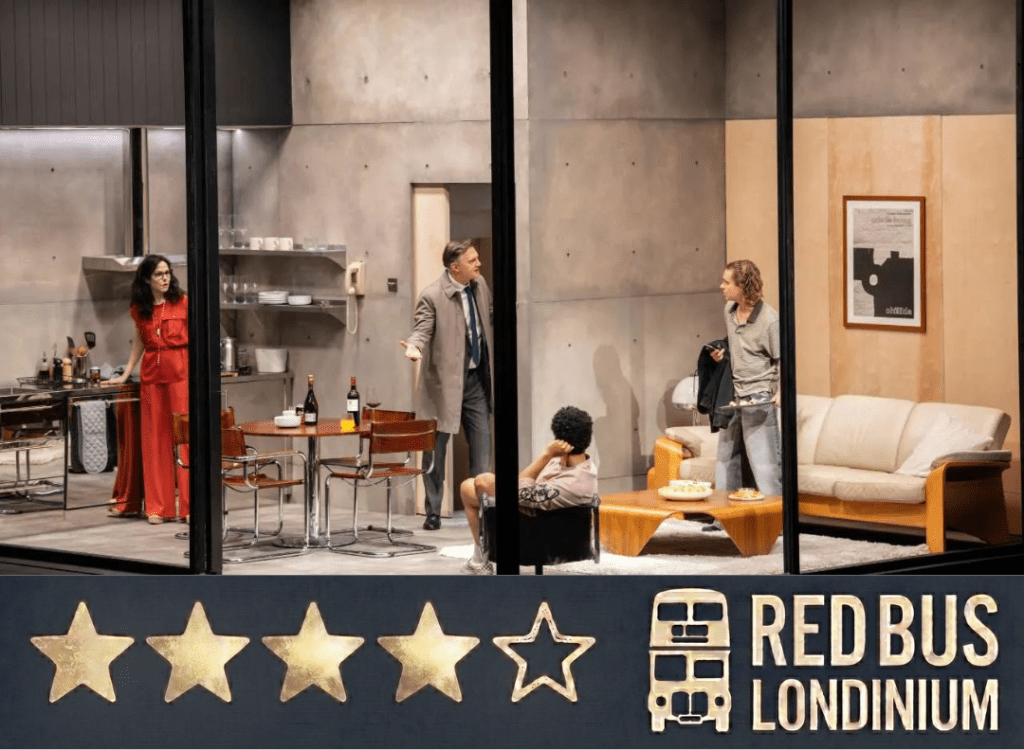
Simon Stone’s Oresteia opens on a family that has clearly done very well for itself and just as clearly hasn’t earned an ounce of peace from it. Christopher (David Morrissey) is a debt-ridden weapons manufacturer holding court in a sprawling Sevenoaks house with his wife Montie (Mary-Louise Parker). It’s a long way from the shrine at Delphi, and yet it isn’t, really. That’s the trick of the evening.
Stone knows Aeschylus well, having reworked this same trilogy twice before, in Germany. This is only two thirds of the story, though: Agamemnon and The Libation Bearers are here, reshaped, but there’s no trial, no Eumenides. The play stops with the killing, not with the reckoning that follows it in the original. We have the a family story about how violence gets handed down, not a civic one about how societies eventually try to stop it.
The daughter we don’t see is the hinge of the whole thing. As the play unfolds we learn she has protested against her father’s business, been silenced for it, and taken her own life on her twenty-first birthday. That’s the modern Iphigenia, and it’s Montie’s justification for everything that follows. Christopher, meanwhile, brings home Chandra (Rakhee Thakrar), reworked here as restorative justice champion rather than a war prize. She’s convinced he was murdered rather than that his death was any kind of suicide, a small but telling shift from the original, where Cassandra simply foresees a death nobody will believe. Her dialogue is some of the best-observed writing in the piece, all wheedling, understanding and compromise, the sound of someone used to trying to find unity amongst people who aren’t listening.
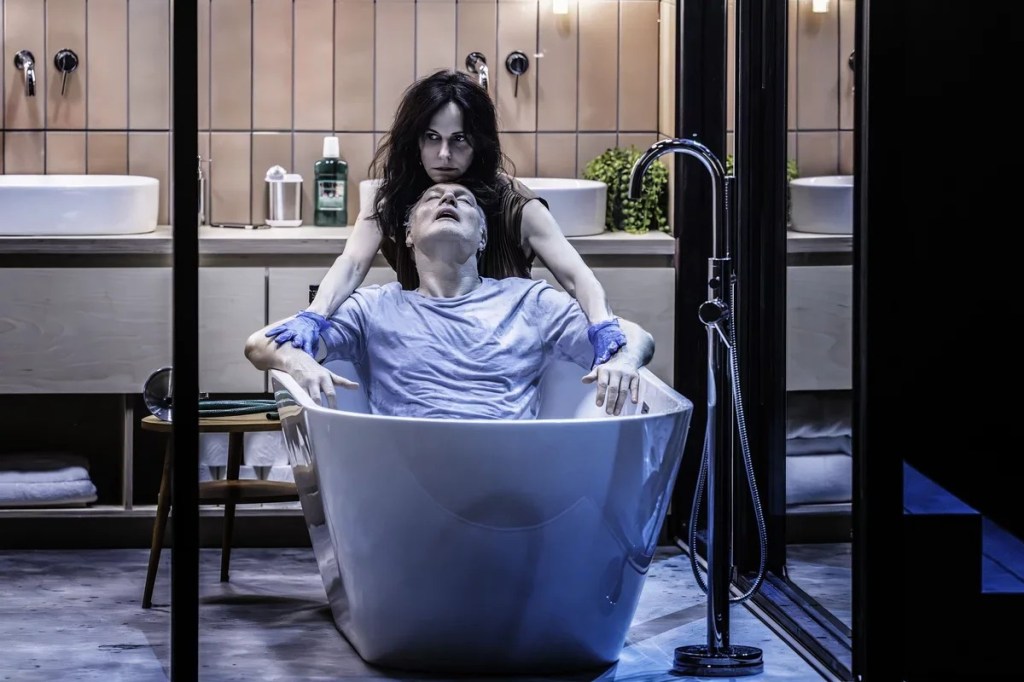
What struck me most was how personal Christopher’s murder feels. Montie doesn’t delegate it or flinch from it: she oversees it herself, and the killing plays less like spectacle than like something reached for out of twenty years of marital wreckage. It’s intimate in the worst way, which is exactly right.
Alice (Rosie Sheehy)‘s absence from the actual killings is worth pausing on, because it isn’t the liberty it might look like. In Aeschylus, Electra all but vanishes from the play once she and Orestes have hatched their plan together; it’s Sophocles who later gives her a hand on the blade. Stone is arguably being faithful here, not radical. But the effect in this staging is to hand the entire weight of the violence, and with it all the attention, to a haunted Augie (Tom Glynn-Carney). His PTSD becomes the play’s engine, while Alice is left holding grief for both her father and her sister with nowhere to put it. Alice is well played. The part just doesn’t give her anywhere to go.
The design does a great deal of the storytelling. The set revolves, and it shocks every time it turns to reveal how a scene has changed, more than once turning up bloodied when you least expect it. At each interval it leaves you with a proper cliffhanger: the interval bar, a desirable rich-person’s space, is subtly doubling as a crime scene the whole time. Projected dates keep the chronology clear without ever feeling like homework. The costuming doesn’t need to do much beyond rooting us in 2026, and it doesn’t try to.
I had what the theatre calls a restricted seat in the balcony, and lost almost nothing, certainly nothing that mattered. The house around me was attentive for the best part of four hours, which is a proper test of any production’s pacing, and this one held its nerve throughout.
Practicalities: there are two intervals, and you’re free to nip outside for either. The ice cream stand does a good line, from tiramisu to a very respectable dark chocolate sorbet, so budget a few extra minutes if you’re tempted. If cost is a concern, Young Bridge members can access £25 tickets in Gallery 2, and groups of ten or more get a substantial discount on top-price seats. There are also audio-described, captioned and BSL performances scheduled later in the run, worth knowing about if access is a factor for you or whoever you’re going with.
Whom would I send? Someone with the stamina for a long night, who’d be satisfied to see an ancient story applied so squarely to modern concerns: generational trauma, the corrosive comfort of money, the way weapons manufacturing has a habit of finding its way into other people’s wars. It’s a savage look at how violence passes down the generations, all the way from Ancient Greece to suburban living rooms.
Images credit: Johan Persson
Latest reviews:
- Review: Oresteia, Bridge Theatre

- Pride, National Theatre (Dorfman) ★★★★

- Review: Good For Her!, The Other Palace ★★★

- Review: Here Comes J. Edgar!, King’s Head Theatre ★★★★

- Review: Abigail’s Party, Richmond Theatre (and on tour) ★★★★

- Review: Avenue Q, Shaftesbury Theatre ★★★★

- Review: Local, Finborough Theatre ★★★

- Review: Tender, Bush Theatre ★★★½

- Review: To Kill a Mockingbird, Wyndham’s Theatre ★★★★

- Review: Archduke, Royal Court ★★★

- Review: Last Goal Wins, Broadway Theatre, Catford, ★★★★½

- Review: Kinky Boots, London Coliseum ★★★½

 Red Bus Londinium Life