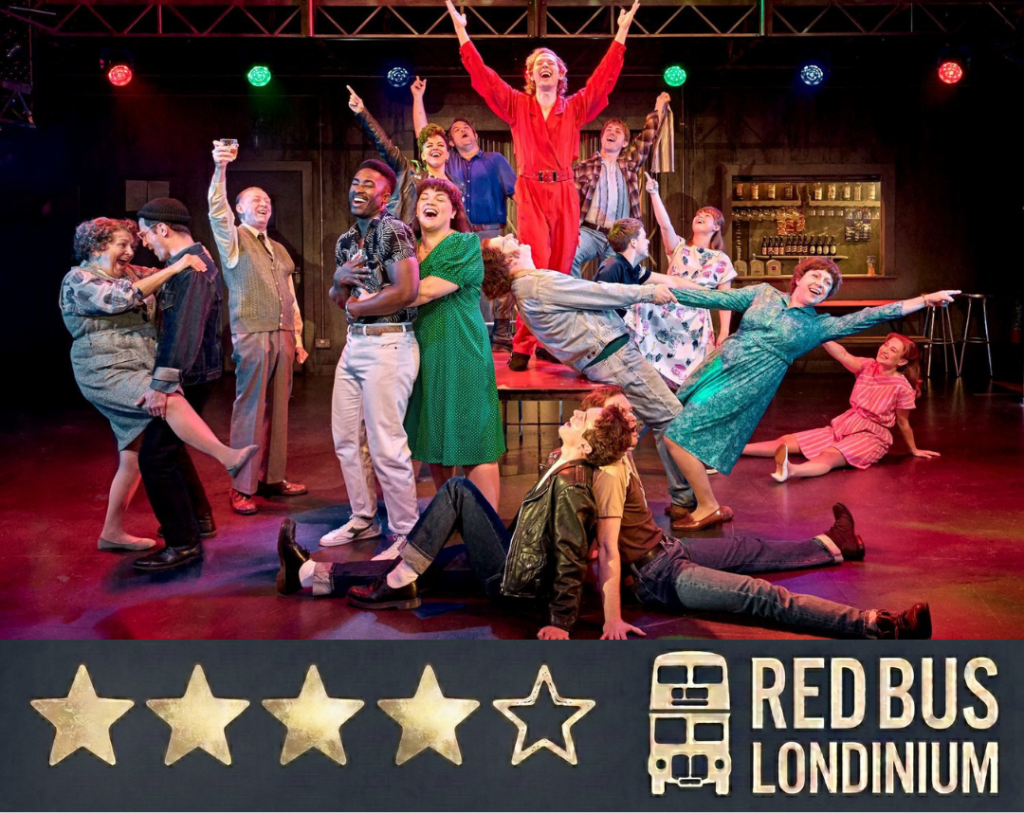
Before a word is spoken, a slideshow runs as the audience takes their seats: Prince Harry’s birth, Reagan visiting Thatcher, the Queen, Wham, all cut to a soundtrack doing the time-travelling for you. It’s a well-constructed bit of scene-setting, casting us straight back to 1984, when gay people had few rights and the police at a Pride march were the enemy, not fellow dancers in it. It does real work before the show has properly started.
LGSM began, according to the story this show tells, with a bucket. Two young activists collecting for the striking miners at the 1984 Pride march, on the grounds that the police who kettled them on marches were the same police roughing up men on picket lines. Shared enemy, shared cause.
Beresford and Warchus, returning to the material they first brought to screen in 2014, have built the stage version around the same alliance: a London gay support group twinning with a Welsh mining village, the money raised going toward a minibus and a lot of mutual education. I went in wondering whether a story this well-loved on film needed a musical version at all. Mostly, I came out glad it exists, not least because a live audience gets to do something a cinema audience can’t: it can cheer.
And cheer it did. The response at the curtain was instant and full, whoops and all, before the cast had even settled into their bows.
Too many people, not enough time
Where the show strains is pacing. There’s a lot of story here, and I found myself asking, more than once, whether every character needed their own arc. Gethin and Bromley are each given their own separate coming-out story, running in parallel, and having two of these rather than one started to feel like clutter rather than two strands each pulling their weight. This is a show that wants to honour everyone who was actually there, which is a lovely instinct and a genuine structural problem. Trim a storyline or two and I suspect the emotional hits would land harder, not softer.
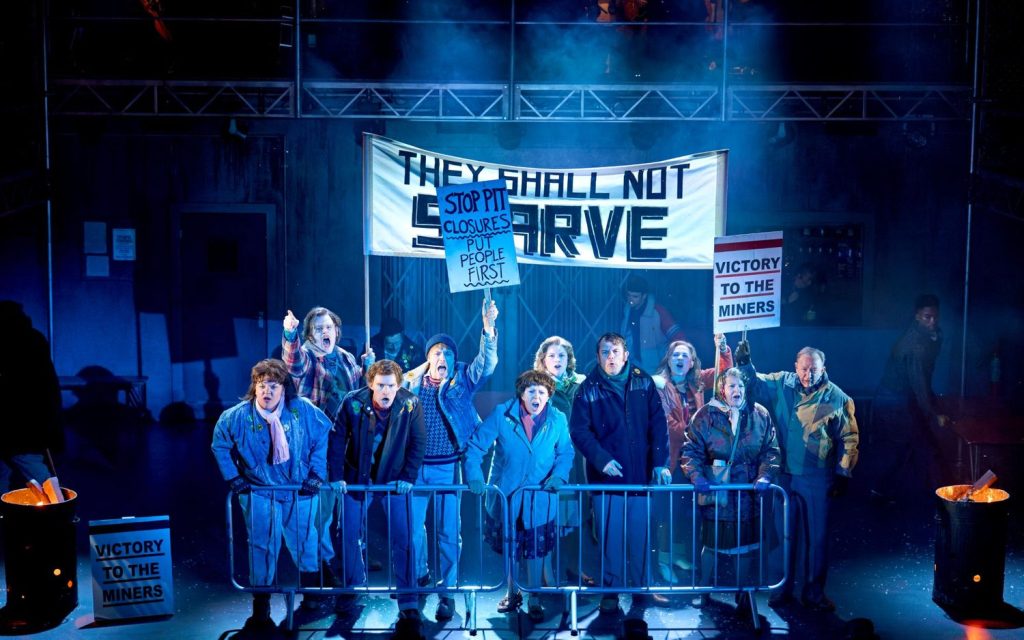
That same crowding raised a harder question for me: whether the AIDS crisis, by the second half, was given more narrative weight than what the miners themselves lost. Both are real and both matter, but the show’s sympathies seem to settle more heavily on one side of its own alliance than the other, and I’m not convinced that was a deliberate choice rather than simply where the more dramatic material lay. I also wondered whether Stef, one of the few women in the LGSM group, could have been given more to do. She’s present throughout but rarely central, and in a show this crowded with men’s arcs, that felt like an opportunity not quite taken.
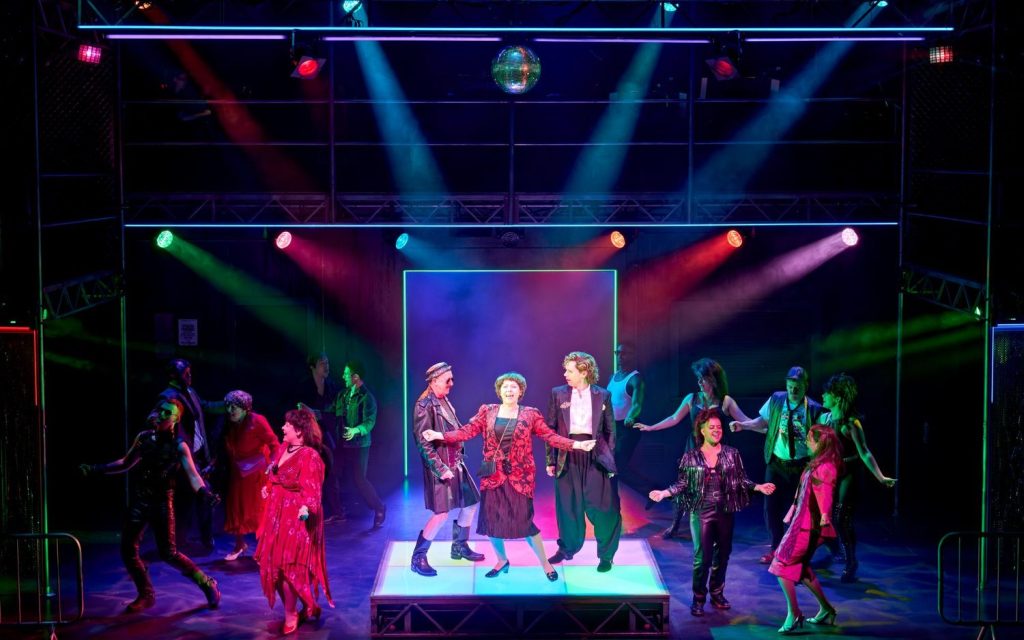
The production earns its size, though. The set has to become a Welsh village hall, a Soho gay bar, a picket line and more besides, and it manages the shifts without ever feeling like a warehouse of separate boxes. Hugh Vanstone‘s lighting does a lot of the heavy lifting: a spotlight that visibly narrows and widens around Jonathan’s big post-interval number, and, elsewhere, a scatter of small individual lights that catches you before you’ve worked out why. Bunny Christie‘s costumes reward close attention too. Cliff, a miner rather than one of the LGSM crowd, wears his union badges pinned to his suit lapel throughout, a detail so quiet I nearly missed it and was glad I hadn’t.
One thing I did miss, from my seat over on the side: an empty chair that clearly carried real symbolic weight was placed off to one side of the stage rather than centre, and I lost it almost entirely. It felt like the kind of detail that shouldn’t depend on where you’re sitting, and I’d push it more centrally if I were staging it again.
The show is honest, too, about tension not always resolving the way you’d want. Because this is drawn from what actually happened, it doesn’t manufacture a clean win for solidarity every time. Village small-mindedness and outright hostility get to win moments in this story, not just lose them, and the show is braver for not smoothing that over.
The humour lands harder than I expected from a show built around a strike and an epidemic. The Welsh women’s reaction to a night out in a Soho leather bar got one of the biggest laughs of the night, delivered with a “this is actually for us” gleefulness rather than shock. Earlier on there’s a call-and-response chant, cheeky rather than crude, that plays with the old “is that policeman really straight” pride-march joke.
When solidarity meets shame
The performance chemistry works at every level: within the LGSM group, within the village, and crucially between the two, where you can watch trust build in real time rather than being told it’s happened. Darren Lawrence’s Cliff has one of the evening’s quietest, most painful moments, a scene where he’s expected to speak up for LGSM to people who matter to him and simply can’t get the words out. He visibly shrinks, and it says more about the cost of solidarity than any of the show’s bigger set pieces. Gillian Elisa‘s Gwen is sharp company throughout, clearly relishing everything her character is discovering about a wider world.
Samuel Barnett‘s Jonathan is the performance I keep thinking about. His post-interval number is a genuine high point, doing something difficult: being funny and devastating in the same breath, without either cancelling the other out. It matters, watching it, that Jonathan is one of the ones who lived. The show doesn’t shy away from what that meant for the people who didn’t. The AIDS requiem later on borrows its language of “light perpetual” from Anglican liturgy, and it landed with real weight, not least because so many men who died in the early years of the epidemic would never have had a funeral in their own family church to begin with.
A version of the old protest song Bread and Roses is performed with real beauty. It’s a song I have always loved, reflecting the idea that workers need economic survival, “bread”, but also dignity, respect and a decent quality of life, “roses”. Pride understands this instinctively. The Welsh villagers here are never reduced to hardship alone; the show consistently gives them dignity, letting them be funny, stubborn, curious and proud, not just people in need of rescue or money. That’s no small thing for a story about a mining community written decades after the fact, and it’s part of why the alliance at the centre of the show feels earned rather than sentimental.
This is an enjoyable telling of an important story, though perhaps it needs to settle on a few key storylines, and give one or two of its quieter characters more room, rather than trying to give every story behind it equal weight.
- December 1981 — The first UK AIDS-related death is reported in a Lancet case report of a 49-year-old man who died at Brompton Hospital in October that year, a homosexual man who had frequently visited the United States. First UK cases had been identified that same winter.
- 6 March 1984 — The miners’ strike begins, called by the National Union of Mineworkers against pit closures.
- 30 June 1984 — LGSM is founded in London, after founding members Mark Ashton and Mike Jackson, having attended a talk by a striking miner, take collection buckets to London Gay Pride that June.
- 15 July 1984 — LGSM is formally constituted as a group, shortly after that Pride collection, and begins meeting weekly at Gay’s the Word bookshop to organise fundraising.
- 10 December 1984 — The Pits and Perverts benefit concert is held at the Electric Ballroom in Camden, featuring Bronski Beat, raising thousands of pounds for the miners.
- 3 March 1985 — The miners’ strike ends, the NUM voting to return to work without securing its aims against the pit closures. The defeat was a heavy one for mining communities.
- June 1985 — The NUM and mining communities of South Wales join LGSM at the head of the London Pride march in an act of solidarity.
Photos credit: Manuel Harlan
Young Person’s Discounts at The National Theatre
Check out my article on the incredible discounts the National Theatre has available for young people.
Latest reviews:
- Review: How the Other half Loves, Old Vic ★★★★

- Camden Fringe Review: Love vs Fear and My Mother’s Prayers, ★★★★

- Camden Fringe Review, TAPE ★★★½

- Camden Fringe Review, Wilder! ★★★½

- Camden Fringe Review: The Barber of Seville, Opera Kipling ★★★★

- Review: Love’s Labour’s Lost & Much Ado About Nothing, OT on the Hill ★★★★½

- Review: Republic of Silence, Riverside Studios ★★★½

- Review: The Truth, Apollo Theatre ★★★★

- Review: Cleansed, Almeida ★★★★
- Camden Fringe Review: This App Is a Haunted House ★★½

- Camden Fringe Review: Bathroom, Etcetera Theatre ★★★½
- Review: Matthew Bourne’s The Car Man, Sadler’s Wells ★★★★★

 Red Bus Londinium Life