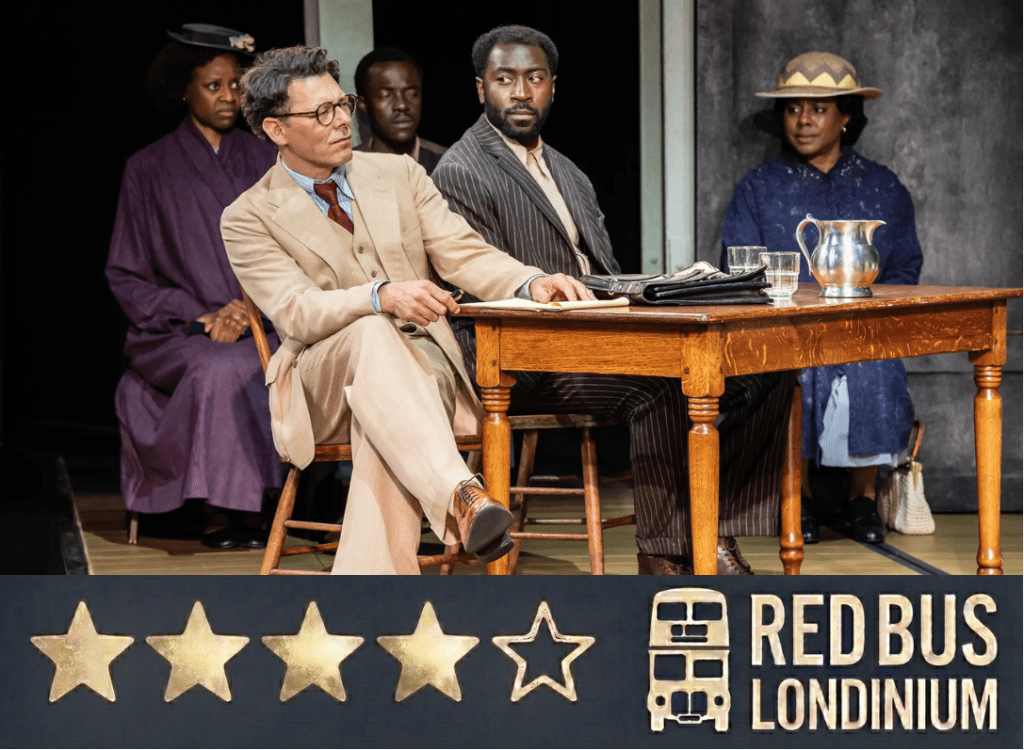
Sorkin’s pacy, taut adaptation makes Maycomb’s values, and ours, hard to look away from
When the novel One Flew Over the Cuckoo’s Nest came out in the 1960s, looking back at the 1930s, it was a radical look at small town racism, banned in some Southern states. Looking at it now, we can see it is dated in its own way, with Atticus Finch essentially cast in a white saviour role. As a play, we get to enjoy examining both levels at once. It is a book so embedded in how many of us understand the era that revisiting it feels worthwhile, even as we recognise it is not something we would necessarily accept if it were written today. Sorkin’s stage adaptation, written in 2018, and now playing at Wyndham’s Theatre adds a third layer: how the story reads through the lens of a decade in which the line “very fine people on both sides” was used by a president when one side were neo-Nazis.
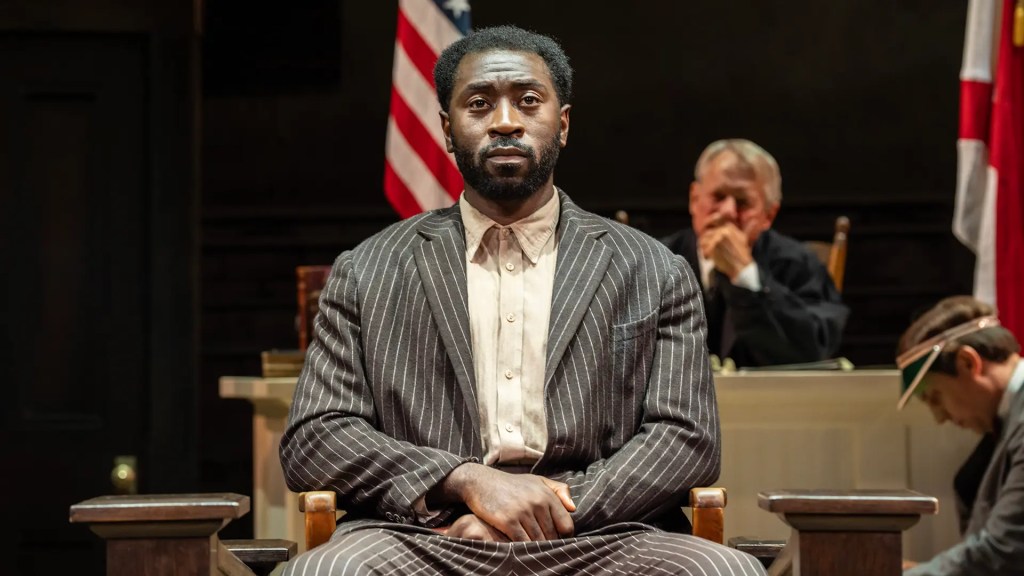
Tom Robinson, for example, is played with quiet and resigned dignity by Aaron Shosanya. He has a clear eyed view of his own position from the moment he is charged: he knows he will be found guilty, and wants to choose the route that spares his children the worst of it. Finch’s gamble, which is presented in the book as purely heroic, essentially denies him that choice. Finch’s insistence that everyone is good at heart, and his habit of excusing prejudice by pointing back to a long finished civil war, rings differently today too.
Aaron Sorkin, who adapted the book for the stage, seems to know it, and has enlarged the role of Calpurnia, played with strength and poise by Andrea Davy, so she can voice some of what the Black community in Maycomb is actually feeling. Her remark that being civil to everyone can end up wounding the people on the receiving end of that “civility” lands hard. It brought to mind Desmond Tutu‘s line about the elephant with its foot on the mouse’s tail: neutrality, in that situation, is not much comfort to the mouse.
You can feel Sorkin’s West Wing background at work throughout. The courtroom scenes in particular have that same fast, pacy repartee. The writing is taut, and that tautness makes the tension mount: the stakes feel higher and the result more tenuous as the trial progresses.
The class insights are laid clear too. Finch calls Mayella “Miss” and “Ma’am,” and believes he is being respectful. Mayella hears mockery in it instead, certain that a man of his standing could not possibly be addressing her, a poor white girl, with genuine courtesy. Neither is wrong about their own experience and the gap between the two readings highlights the gap between lives in Maycomb.
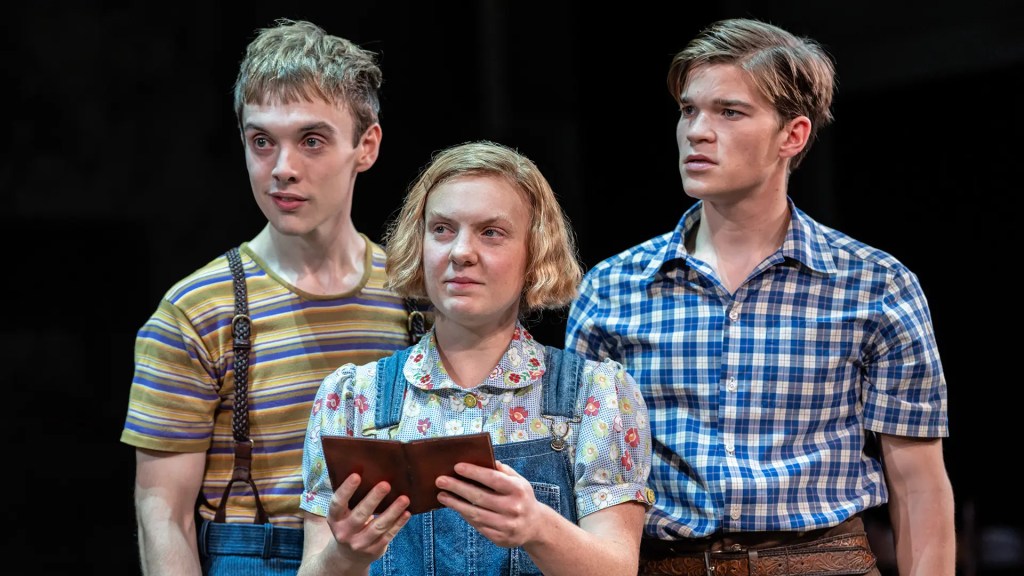
Scout, Jem and Dill work as narrators and characters simultaneously, driving the story forward through a child’s eye view that gives us a clear lens on the sometimes illogical or inconsistent actions of the adults around them. They have real charm as a trio, and their teamwork is part of what holds the play’s non-linear structure together.
Anna Munden, as Scout, captures the exuberance and zeal of youth with a childlike physicality and tenacity. Dylan Malyn‘s Dill skilfully layers pain underneath bravado, and his playful scenes with Jem sit alongside a growing awareness of adult stakes, such as when he offers to stand by Finch in a confrontation. Gabriel Scott‘s Jem is just as assured, tracing that stretch of adolescence where a child starts becoming a man; by the time of the trial, he understands the arguments fully, and we can see his childhood idealism draining away.
Richard Coyle’s Finch is idealistic and firm in his morals, visibly trying to raise his children right even as the play quietly asks us to question whether that is enough. For this is also a story about parenting and values, and about what gets handed down. Mayella repeats, almost verbatim, views she has plainly absorbed from her father, about whites having built Europe while black people, in her telling, could not even build roads in Africa. It is racism passed down the generations, taught rather than reasoned. Finch is trying to pass down his own values in the same way, even as the belief at the centre of them, that there is good in everyone, is disproved around him, choice by choice, by the townspeople of Maycomb.
The set, by Miriam Buether, makes clever use of moving parts, allowing the ensemble to assemble and disassemble the Finch house, the courtroom and the prison in full view. It is largely wood, and thoroughly plausible as the American South. It is also, at times, a little noisy, with the scene changes sometimes intruding on quieter moments.
Lighting, designed by Jennifer Tipton, is used to great effect throughout, with shadows cast and highlights thrown in ways that quietly steer where your eye goes, particularly in the courtroom.
The hymn “Hope Riseth in the Morning” was one of the evening’s most moving passages, the kind of moment that stays with you as it comes in on Calpurnia’s logic that morning sure is a long timing coming. Recent political divisions would show that she is right.
The costumes, by Ann Roth, further underline the class system at play. You notice the stained, ragged state of the farmers set against the buttoned up townspeople, and then notice something sharper: the Black residents they all look down on are, in fact, better dressed than the farmers doing the looking down. Scout’s ham costume for the school pageant is a triumph, and got exactly the reaction you’d expect.
The one by one narration of the word “guilty,” twelve times over, is painful to sit through. It needs to be.
The play is never dull, but it would likely be tighter, and more satisfying overall, if the scenes involving Boo Radley and Dill’s mother were cut, as neither adds much that the rest of the production isn’t already doing more effectively, and the ending, built around the two knives, felt rushed and less clear than everything that had come before it, which was a shame after so much care elsewhere.
Even so, this is a powerful night at the theatre, and one that leaves you thinking on two levels at once: about what values the residents of Maycomb have internalised without ever questioning them, and about what understanding we, as readers of To Kill a Mockingbird, may have internalised from the book, and ought to look at again with more modern eyes.
Photos credit: Johan Persson
- 1819 Alabama becomes a US state
- 1861 to 1865 American Civil War
- 1865 Slavery abolished under the 13th Amendment
- 1870 The 15th Amendment grants Black men the vote on paper, though it would be blocked in practice across the South for decades
- 1934 The year the novel, and this production, is set
- 1935 Norris v Alabama rules that Black jurors cannot be systematically excluded, following the Scottsboro Boys case, though enforcement lagged well beyond the ruling
- 1955 to 1956 The Montgomery Bus Boycott, sparked by Rosa Parks’s arrest in Alabama, runs for 381 days
- 1960 Harper Lee publishes To Kill a Mockingbird
- 1965 The Voting Rights Act begins to make Black voting rights a reality in the South, including Alabama
To Kill a Mockingbird is playing at Wyndham’s Theatre until 12th September.
Latest reviews:
- Review: Matthew Bourne’s The Car Man, Sadler’s Wells ★★★★★

- Review: Dark of the Moon, Charing Cross Theatre ★★★

- Camden Fringe Review: Asian Pirate Musical, Upstairs at the Gatehouse ★★★½

- Review: The Importance of Being Oscar, Park Theatre ★★★★

- Camden Fringe Review: 1918: The Final Salome, Etcetera Theatre ★★½

- Review: Cyrano de Bergerac, Noël Coward Theatre ★★★★½

- Review: Firebird, Southwark Playhouse ★★★★

- Review: Oresteia, Bridge Theatre

- Pride, National Theatre (Dorfman) ★★★★
- Review: Good For Her!, The Other Palace ★★★
- Review: Here Comes J. Edgar!, King’s Head Theatre ★★★★

- Review: Abigail’s Party, Richmond Theatre (and on tour) ★★★★

 Red Bus Londinium Life