
Comedy musical traces Hoover’s blackmail, his devotion to Clyde Tolson, and the secrets behind an FBI legend, at King’s Head Theatre this summer
Here Comes J. Edgar! has taken more than thirty years to reach London properly. Harry Shearer first staged the character back in 1994 in Santa Monica, with music by Peter Matz, who died in 2002 without ever seeing it land here. A London transfer was mooted in 2011 and quietly went nowhere. So this King’s Head run, co-written with Tom Leopold, only now gets its full production, as a genuine world premiere.
J. Edgar Hoover ran the FBI for 48 years, and the show is essentially a portrait of a man determined to control everyone around him, staff and presidents alike, while keeping his own life hidden. Whose story is being told is never in doubt: it’s Hoover’s, told through his relationships. That’s where the real interest lies, not in crime-fighting mythology but in what it shows about changing attitudes to gay relationships, and how one man’s need for secrecy helped shape one of America’s most significant institutions.
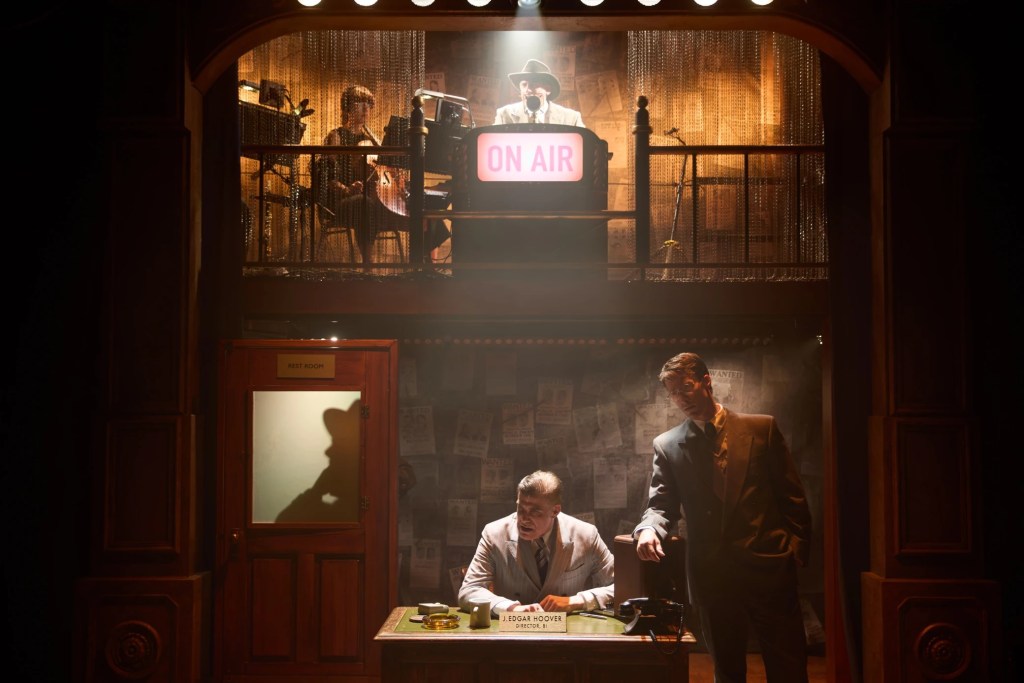
Josh Seymour directs a cohesive production that holds together well for a comedy musical, and the story stays clear throughout. Sophia Pardon‘s set does a lot of work in a small space: the same desks become Hoover’s office and a president’s office; a radio station overhead, and, in one clever and genuinely funny sequence, the stage becomes a toilet stall.
Bill Deamer‘s choreography fits each scene, whether a feverish party teetering dangerously out of control or a crowd of busy commuters, and Tom Paris‘s costumes carry real humour of their own: Clyde’s instant reveal of a pink outfit, a stageful of coloured fox furs at the races.
Jamie Platt‘s lighting earns its keep, particularly in that toilet scene, shifting mood cleverly. Nick Lodge‘s sound balances the live music and singing well throughout.
Bryan Batt‘s Hoover carries genuinely different relationships with everyone around him: controlling the presidents he serves under (among them Ryan Heenan‘s Eisenhower, Reuben Khan‘s Kennedy, Simon Anthony‘s Lyndon Johnson), he idolises his mother, and is repeatedly undone by his feelings for Hugo Bolton‘s Clyde Tolson, feelings he can never show in public even as they’re the one thing that seems to make him human. That contrast, a man whose roles make him strong even as his hidden desire leaves him vulnerable, is the show’s most successful throughline.
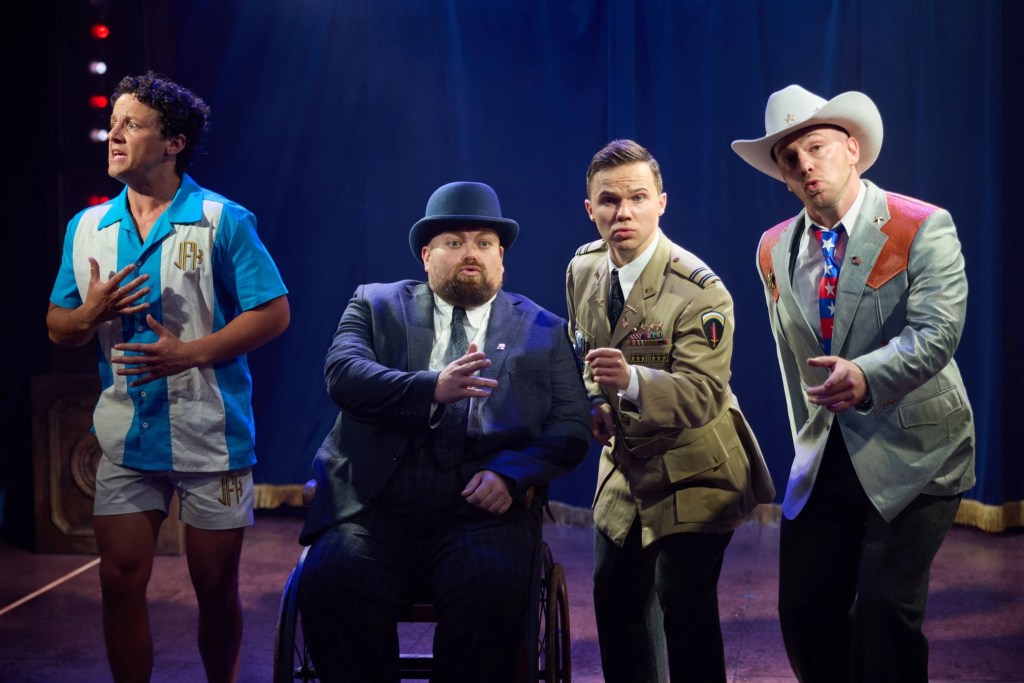
Laura Medforth, as Helen, gets one of the production’s best moments, a scene where Hoover kisses her that shows off phenomenal comic and choreographic skill. Helen’s own position is handled carefully too, caught between respect for Hoover and something closer to quiet resignation at being taken for granted. It’s rooted in fact: Hoover’s real secretary worked for him from 1918 until his death in 1972, and reportedly spent weeks destroying his private files before retiring.
Elsewhere, Martha Pothen brings real comic movement to her roles, and Alfie Parker has a presence that draws the eye whenever he’s on stage, fully committing to whichever part he’s playing, Roosevelt and “Tony Clownpants” among them.
There’s also an interesting strand on the rise of Joseph McCarthy, whose 1950 Wheeling speech launched him to sudden national fame before his fall a few years later. It’s a nice touch, given the show’s interest in the gap between Hoover’s public and private selves, that Hoover’s own FBI investigated allegations of McCarthy’s homosexuality in 1952 and shrugged them off, concluding only that “homosexuals are very bitter against Senator McCarthy.” The production doesn’t dwell on it, but it’s exactly the kind of detail that makes the whole enterprise feel like more than a novelty biography.
The dialogue sounds real for who these characters are, though some of it is knowingly overplayed, leaning into the comedy of the piece. The stakes stay clear throughout: Hoover wants control, and he needs to keep the real shape of his relationships hidden from view. That clarity keeps a genuinely big story working inside a genuinely tiny venue; somehow, everything fits.
From my seat down the side, I could only see the back of Clyde during the final farewell scene, a real loss given how much of the show’s feeling lives in that relationship. Everything else was blocked well and views were excellent.
The house gave a standing ovation, and the laughter was warm throughout. I couldn’t hum you a single tune afterwards, but in the moment, the songs did exactly what they needed to for the story.
This is a piercingly funny, comic piece examining both Hoover’s power and his vulnerability, and one that earns its length without ever losing its grip on the story.
If you want to catch it, King’s Head Theatre always holds ten tickets at £10 for every performance, and there’s a 15% Access Scheme discount plus a free companion ticket where needed. Under 35s and N1 residents could get £10 tickets for the early previews (11-13 July), and Under 35s and KHT Artists Club members get £15 tickets for off-peak performances throughout. It runs at the King’s Head until 16 August.
- 1917: Hoover joins the Department of Justice, aged 22.
- 1919: Aged 24, he leads the Bureau of Investigation’s new General Intelligence Division and helps coordinate the Palmer Raids during the First Red Scare.
- 10 May 1924: Hoover is appointed Director of the Bureau of Investigation, aged 29.
- 1930: Clyde Tolson, hired as a special agent in 1928, is promoted to Assistant Director, beginning his 42 years as Hoover’s deputy.
- 1935: The Bureau of Investigation is renamed the Federal Bureau of Investigation.
- 1950: Joseph McCarthy’s Wheeling speech, claiming a list of Communists in the State Department, launches his rise to national prominence.
- 1956: Hoover formalises COINTELPRO, the FBI’s covert programme of surveillance and disruption against people he deemed subversive.
- 1954: The Senate votes to censure McCarthy; his influence collapses soon after.
- October 1963: Robert Kennedy authorises FBI wiretaps on Martin Luther King Jr.’s home and SCLC offices.
- 24 November 1963: Hours after Lee Harvey Oswald is shot, Hoover dictates a memo pushing for “something issued so that we can convince the public that Oswald is the real assassin.”
- 21 November 1964: The FBI sends King an anonymous letter and tape, widely interpreted as pushing him toward suicide.
- 2 May 1972: Hoover dies at home, aged 77, having led the Bureau and then the FBI for 48 years. Tolson, briefly acting director, retires two days later at Hoover’s funeral.
Photos credit: Mark Douet
Latest reviews:
- Review: Here Comes J. Edgar!, King’s Head Theatre ★★★★

- Review: Abigail’s Party, Richmond Theatre (and on tour) ★★★★

- Review: Avenue Q, Shaftesbury Theatre ★★★★

- Review: Local, Finborough Theatre ★★★

- Review: Tender, Bush Theatre ★★★½

- Review: To Kill a Mockingbird, Wyndham’s Theatre ★★★★

- Review: Archduke, Royal Court ★★★

- Review: Last Goal Wins, Broadway Theatre, Catford, ★★★★½

- Review: Kinky Boots, London Coliseum ★★★½

- Review: Relics, Lyric Hammersmith ★★★★

- Review: Rayuela: Compañía Marco Flores, Sadler’s Wells East ★★★★

- Review: Lost the Plot, Omnibus Theatre, Clapham ★★★★

 Red Bus Londinium Life