
Port of Spain, 1956. The old British colonial world is cracking open, and a modern nation is struggling to be born. Dr Eric Williams is rallying in Woodford Square, and the recent independence of India and Ghana sends a charge through the air that makes the period feel immediate and alive. Martina Laird‘s debut play does not concern itself with politicians, however. Instead it takes us inside ALMA, a family-run gentlemen’s club on the waterfront, where the port’s restless world of sailors, hustlers and smugglers washes up at the door. “Nastiness” serves as a convenient euphemism for activities best left undescribed.
This is a world of rum, survival and secrets, and almost everyone in it seems to be running some kind of scheme. The underground economy is fuelled by transient visitors and shifting loyalties, and as the story unfolds it becomes increasingly difficult to judge where necessity ends and exploitation begins.
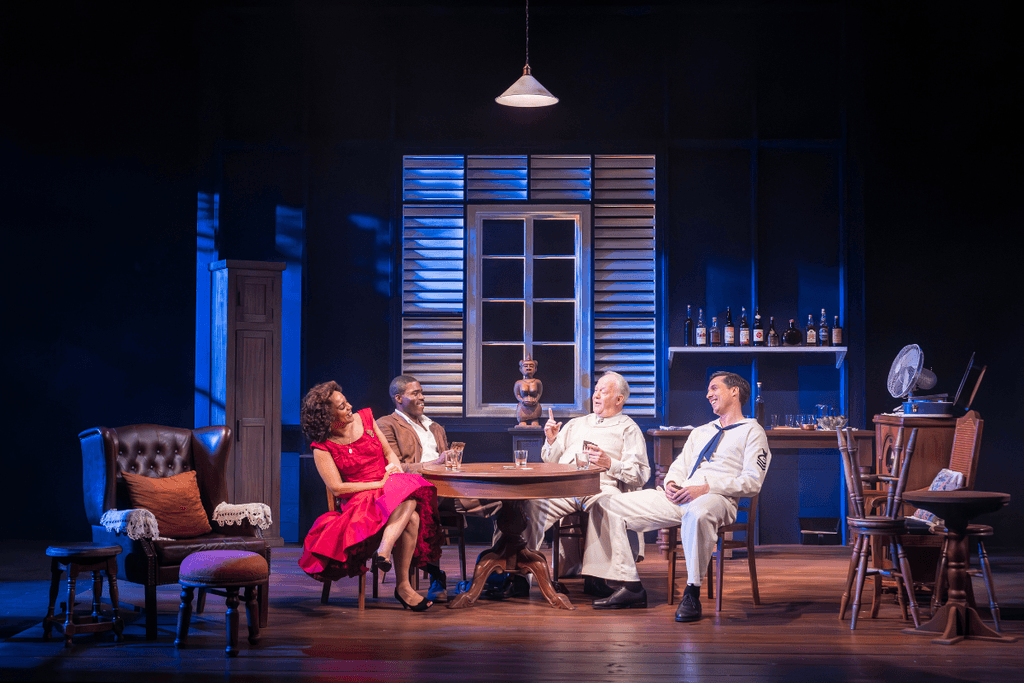
Sadeysa Greenaway-Bailey‘s set design creates a vivid sense of place. Carved wooden panels form the walls of the club, with light filtering through to suggest the passing hours outside. The resulting shadows and patterns constantly reshape the stage. At the beginning and end the walls close in around the action, creating an intimate atmosphere, before sliding apart to reveal a deeper playing space filled with carefully observed colonial-era detail.
Ellen Thomas as Pearl, the mother at the heart of ALMA, is exceptional. Deeply layered and deeply flawed, she bristles with pride whilst her stilted gait, the result of broken shoes, quietly reflects just how precarious her position really is. By the end I found myself wondering whether she was really any different from the other hustlers who pass through her doors, and I am not sure the play entirely resolves that question. It may not intend to.

One of the most touching moments came when Pearl sang Ba moin en tibo, a Creole lullaby that demonstrates the care with which the production has been researched. It lands with the warmth of something genuinely known rather than simply borrowed.
Martins Imhangbe as Diamond is central to the plot. His reckless deal with a US Marine is what sets the action in motion, and he holds the stage with a performance that swings between the bombastic and the vulnerable. This is a man carrying the scars of a hurt boy from his past, and Imhangbe makes you feel the weight of both.
Ziggy Heath ably portrays the brash confidence of a US sailor in Tom, and Cat White as Ruby sensually schemes and dreams alongside her mother.
Roger Ringrose‘s Mansion, an elderly British civil servant who arrived in Trinidad in 1920 to arrange a royal visit by Prince Edward and simply never left, is a portrait of colonial self-deception. He cannot conceive that Trinidadians might successfully govern themselves, and those same assumptions underpin his plans for ALMA. Despite decades spent in the country, he remains determined to leave the house to relatives in Britain, seemingly blind to why the family around him might feel any attachment to it.
Shane David-Joseph‘s police officer Seldom is broader in conception, almost veering into caricature, but he remains hugely entertaining. One particularly memorable scene sees him recounting a search operation, happily chatting away while everyone around him slowly realises what really happened. The moment is beautifully played through reaction, expression and body language.
The production is not without its difficulties. There are perhaps more plot strands than necessary, and because so many of the characters are hustlers and con artists it can become genuinely hard to distinguish truth from performance. There were moments when I felt that uncertainty obscured rather than enriched the drama. A card game that appeared significant was lost to me from where I was sitting, and because everyone on stage was a schemer, I could not easily tell whether the specific play mattered. The gothic ending also feels overstretched, lingering past the point at which its impact has peaked.
Driftwood is an exceptional debut. The places are real, the people are real, the language and music are real. It is a shame that a tighter editing hand has not helped streamline the narrative, because there is a compelling story at its heart that occasionally risks being lost amongst the many others surrounding it. But Justin Audibert‘s production is richly imagined, and Thomas alone is worth the journey to Kilburn.
Image credits: Marc Brenner
Recent reviews:
- Review: Cleansed, Almeida ★★★★

- Camden Fringe Review: This App Is a Haunted House ★★½

- Camden Fringe Review: Bathroom, Etcetera Theatre ★★★½
- Review: Matthew Bourne’s The Car Man, Sadler’s Wells ★★★★★

- Review: Dark of the Moon, Charing Cross Theatre ★★★

- Camden Fringe Review: Asian Pirate Musical, Upstairs at the Gatehouse ★★★½

- Review: The Importance of Being Oscar, Park Theatre ★★★★

- Camden Fringe Review: 1918: The Final Salome, Etcetera Theatre ★★½

- Review: Cyrano de Bergerac, Noël Coward Theatre ★★★★½

- Review: Firebird, Southwark Playhouse ★★★★

- Review: Oresteia, Bridge Theatre

- Pride, National Theatre (Dorfman) ★★★★

 Red Bus Londinium Life