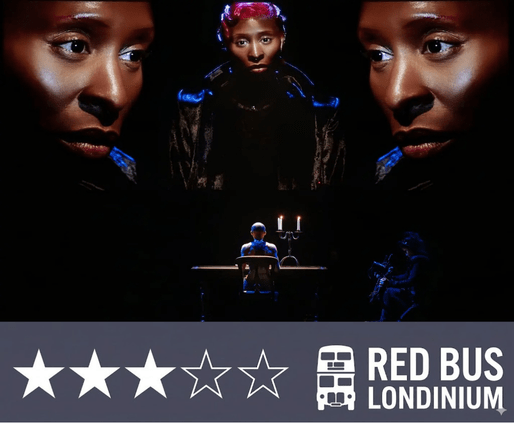
All the technology, not enough terror: when spectacle overshadows both star and story
Bram Stoker’s Dracula is, above all, a novel of creeping psychological dread. It is not a story of jump scares. It is the anxiety that builds when you see a familiar figure across the street, the unease of boxes arriving at a harbour, the slow horror of watching someone you love begin to change. When I have tried to read it alone at night (and I have) I have found I simply cannot. The story seeps into the dark. That is the power Stoker had, and it is the power a theatrical adaptation must find a way to summon.
This is the third and final instalment of Australian writer-director Kip Williams‘ ambitious gothic cine-theatre trilogy, which began with Dr Jekyll and Mr Hyde and found its West End apotheosis in the Sarah Snook-starring, Olivier and Tony Award-winning The Picture of Dorian Gray. That production was a phenomenon. Many of us in the audience for Dracula carry the memory of it with us, for better or worse. My husband, seeing the form for the first time, was appropriately wowed by the technical achievement. For me, returning to Williams’ distinctive world of live video feeds, pre-recorded footage, and a single performer carrying everything, the experience was more complicated.
The conceit is the same: Cynthia Erivo plays all 23 characters in Stoker’s epistolary novel, Jonathan Harker, Mina Murray, Lucy Westenra, Van Helsing, Renfield, and the Count himself, while a team of skilled camera operators relay her performance to a vast screen above the stark stage, blending live feed with pre-recorded footage to create the illusion of multiple simultaneous selves.
And let us be absolutely clear about what Erivo achieves here. This is a remarkable, almost athletic performance. She is lithe and physical on the stage, alive in every moment, and where the production allows her room to breathe, she is riveting. Her two female leads, Mina and Lucy, are genuinely and sharply differentiated, not merely by wig and costume but by posture, by stillness, by the quality of attention in her eyes. Each feels like a complete person. And her Count is something to behold: aristocratic, horrifying, possessed of a terrible charm. She makes you understand why every character in the room cannot quite look away, and cannot quite leave.
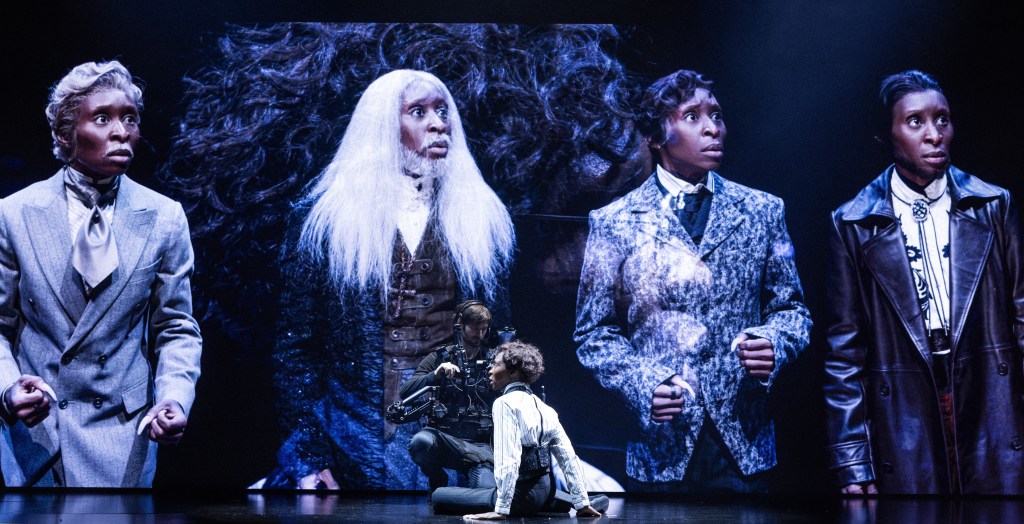
The difficulty is not Erivo. The difficulty is that the production does not always let her be the main event.
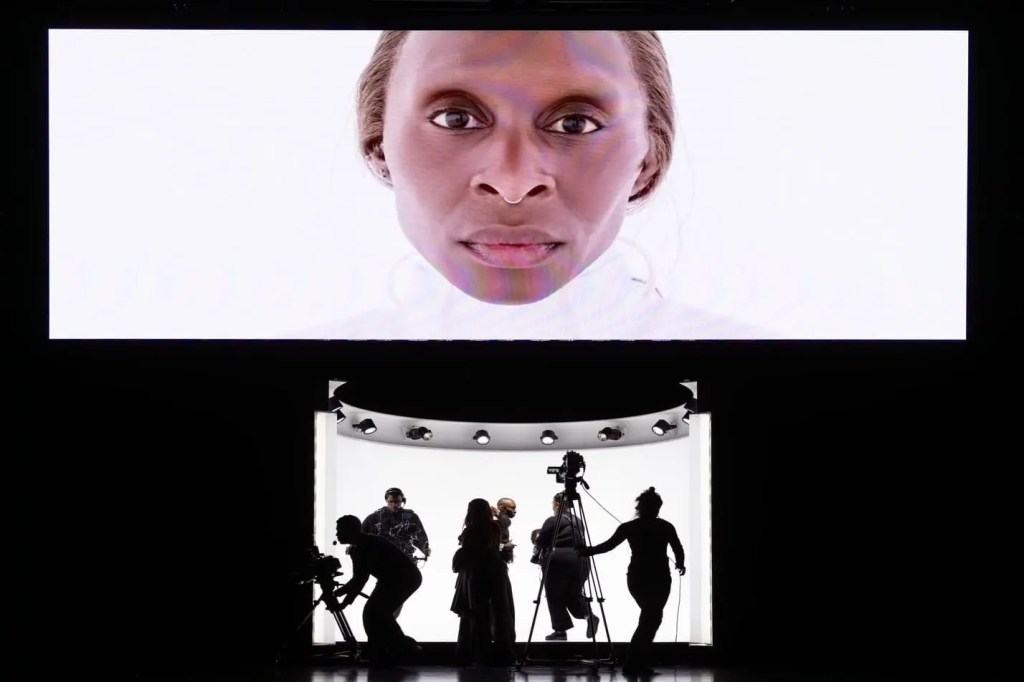
The problem, and it is a real one, is that the screen increasingly takes over. There are stretches where as many as four pre-recorded versions of Erivo dominate the vast display above the stage while the living, breathing performer below is barely visible, surrounded by crew, mid-wig-change, or simply eclipsed by the camera operators working around her.
There is a structural problem with the video that creates a further tension. Some of the pre-recorded material appears to have been locked at a fixed pace, which means that Erivo must deliver her lines at speed to stay in synchronisation with what is coming on screen. The result is that the text is sometimes rushed, and on the night I attended there were at least five noticeable moments when a line was delivered and a telling pause followed: the gap between what she had said live and what the pre-recorded character was waiting to respond to. In a production this technically sophisticated, those pauses register as fault lines.
The costume logic, too, creates moments of confusion that accumulate. Sometimes Erivo changes into a character’s full costume to embody them live. At other times, the costumed character appears only on screen while she plays them in something else entirely, or she switches between characters in a single costume in rapid succession. On its own, any one of these approaches is theatrically coherent. Together, delivered at the pace the production demands, they can make the brain work harder at tracking who she is being than at feeling what is being said. And because this is Dracula, a story most of us know well, the cognitive load should be free for the dread. Instead, it is spent on accounting.
The cinematography has its pleasures. Close-ups and unusual angles transform a very bare stage into something that suggests Transylvanian corridors and a Whitby cliff. The music, Clemence Williams‘ score drawing on classical, Romantic and contemporary sources, with In the Hall of the Mountain King used to particularly fine effect, does real atmospheric work in places.
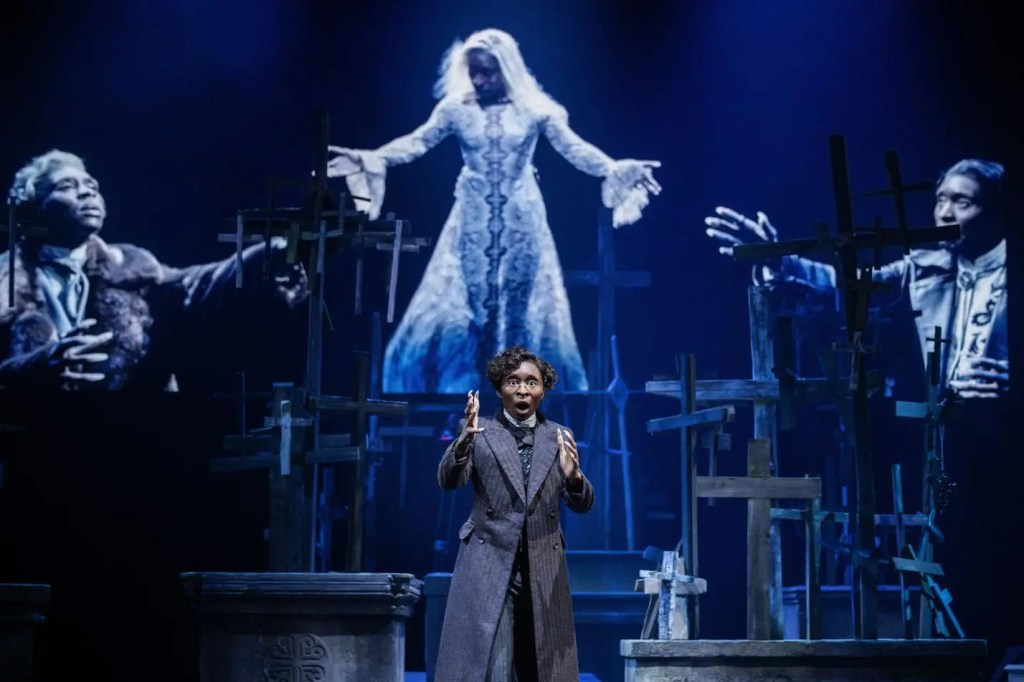
But Whitby never quite feels like Whitby. The seaside, that windswept northern strangeness that makes the harbour scenes in the novel so particular, does not come through. The cemetery sequence similarly misfires. Highgate Cemetery, where Stoker set Lucy’s undead wanderings, is one of London’s genuinely eerie places: vine-covered, Victorian, Gothic in the truest sense, a landscape that has inspired writers and filmmakers for generations. The production does not find a way to evoke it. The psychological unease that made me unable to read the novel after dark is never quite summoned. The pace that drives the production also, paradoxically, prevents the dread from pooling.
Queer threads run through this production. Williams told Playbill: “It’s a very queer retelling of the story, and we are looking at reclaiming the vampire.” London audiences have already been served a bolder treatment of these themes: the Lyric Hammersmith’s Dracula last autumn, Morgan Lloyd Malcolm‘s adaptation told the story explicitly from Mina’s point of view and wore its feminist and queer intentions openly and confidently. By comparison, those same themes feel present here but not fully pressed. Erivo’s Count is piercingly still and genuinely otherworldly, and there is something in that stillness that gestures towards those ideas. But the production does not always seem sure how much weight it wants to place on them, and moments that might have landed with real force pass by in the general rush.
This is a show worth seeing, and Cynthia Erivo is a reason to see it before it closes at the end of this month. Her endurance is extraordinary, her best moments are memorable, and there is something genuinely exciting about watching an artist of her calibre work at this scale. But there is also the nagging sense that the production has hemmed her in: that somewhere inside this technically extraordinary machine is a simpler, darker, more frightening show trying to get out.
Erivo is extraordinary; the machine around her less so. A technically ambitious evening that dazzles in places but too rarely delivers the sustained, creeping dread that Stoker’s story demands.
Dracula runs at the Noël Coward Theatre until 31 May 2026. Recommended for ages 12+. Contains flashing lights.
All photos: Daniel Boud
Latest reviews:
- Review: Here Comes J. Edgar!, King’s Head Theatre ★★★★

- Review: Abigail’s Party, Richmond Theatre (and on tour) ★★★★

- Review: Avenue Q, Shaftesbury Theatre ★★★★

- Review: Local, Finborough Theatre ★★★

- Review: Tender, Bush Theatre ★★★½

- Review: To Kill a Mockingbird, Wyndham’s Theatre ★★★★

- Review: Archduke, Royal Court ★★★

- Review: Last Goal Wins, Broadway Theatre, Catford, ★★★★½

- Review: Kinky Boots, London Coliseum ★★★½

- Review: Relics, Lyric Hammersmith ★★★★

- Review: Rayuela: Compañía Marco Flores, Sadler’s Wells East ★★★★

- Review: Lost the Plot, Omnibus Theatre, Clapham ★★★★

 Red Bus Londinium Life