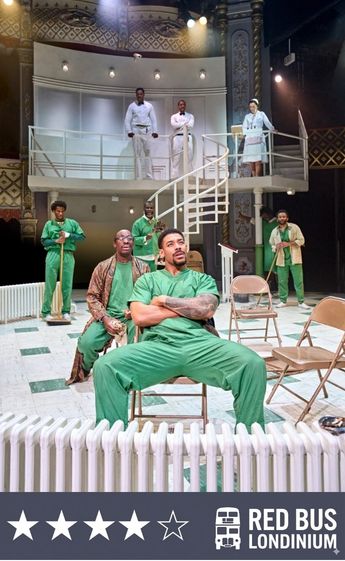
All photos: Manuel Harlan
Reimagining a Classic: One Flew Over the Cuckoo’s Nest at the Old Vic
Clint Dyer’s new production of One Flew Over the Cuckoo’s Nest at the Old Vic brings a reimagining of Ken Kesey’s classic novel to the London stage. I was convinced I already knew this story, having seen so many fragments of it over the years, particularly the widely circulated image of Jack Nicholson in Milos Forman’s film. That image creates a false sense of familiarity. In reality, I had not properly seen it at all. Seeing it on stage at the Old Vic therefore feels like encountering it properly for the first time. Dyer’s version successfully centres the narrative on the stark power dynamics of a 1960s psychiatric ward.
Dyer has made the choice to cast Black patients against a largely white senior staff, which keenly highlights the power divide between them. The pacing drops slightly in Act 1 but picks up beautifully in Act 2 as the protagonist, played by Aaron Pierre, begins to truly understand the power dynamic he is up against as a sectioned patient.
The production is most affecting where it touches on Indigenous land loss. Through Chief Bromden, that history is carried in silence and withdrawal rather than explanation. His father’s alcoholism and his own sense of inadequacy, of not being “big enough”, sit behind his refusal to speak. On stage, this is expressed through his feigned deafness and selective mutism, which read as a coping mechanism we would now associate with anxiety. As a teacher, I found this particularly striking, especially given how little attention was paid to selective mutism when the novel was first written, and how much more we now understand about it in educational contexts. It is a reminder of how much insight Kesey brought from his experience on a psychiatric ward.
The full cast inhabit their roles superbly but Aaron Pierre, in the role of McMurphy, must be congratulated for his performance as he begins as a character full of confidence and verve, only to palpably lose that autonomy as the weight of the institution bears down on him. Seeing the reduced version of him at the end is both bleak and painful.
The costumes are necessarily standard-issue patient and ward clothes which site the play in its clinical environment, but subtle flourishes offer the audience insight into the characters. For instance, Giles Terera’s character sports a handsome smoking jacket as a dressing gown; this sartorial choice immediately gifts him a more professorial, educated aura that distinguishes him from his peers.
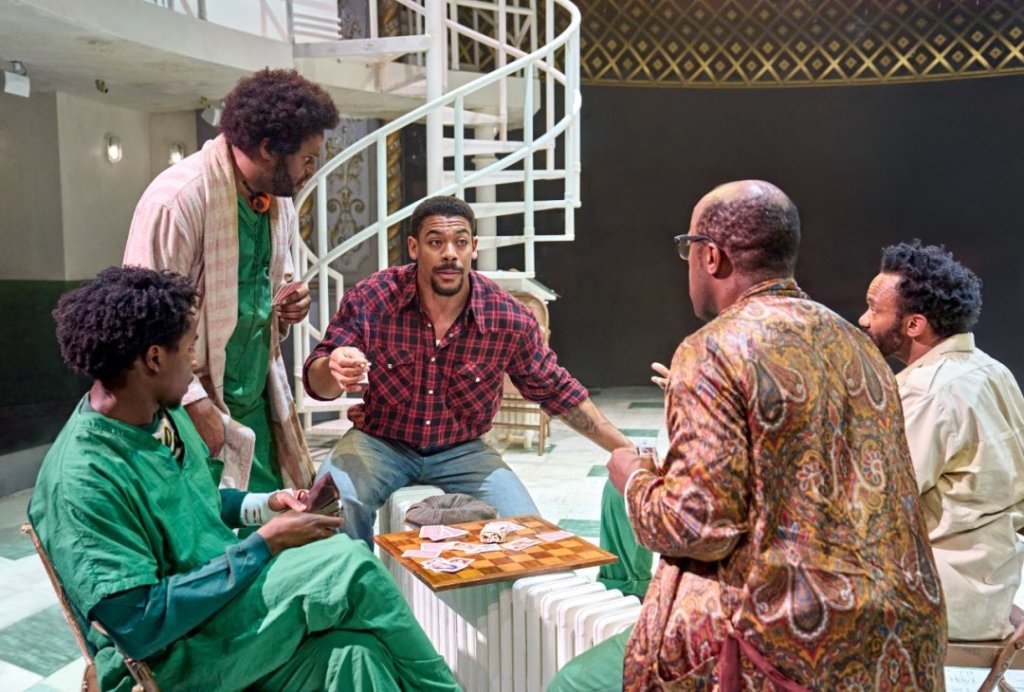
Similarly, the delay in transitioning McMurphy into his drab patient uniform is a clever tactical move. By allowing him to retain his civilian attire for as long as possible, the production gives the audience time to connect with his individual identity before the institution attempts to strip them away.
The staging is very clever, using an in the round configuration to make the audience feel immersed. With a large cast moving through a circular space, you can never quite take everything in at once, which mirrors the uncertainty of a ward built on partial, unreliable accounts. The set features staircases to both sides that allow for dramatic entrances and create a zone for the staff to look out at the patients. The main props, white industrial heaters, do double duty: they reinforce the institutional setting while constantly being reconfigured as seating, platforms, and barriers.
There were, however, a few minor frustrations. The play opens and ends with a setting in Congo Square, a Native American and African American gathering place in New Orleans. While this was a deliberate choice, much of the information was provided on slides set to the sides. Sitting in a central seat, I found it impossible to read them, which is a shame as that context was lost until I read the programme on the train home.
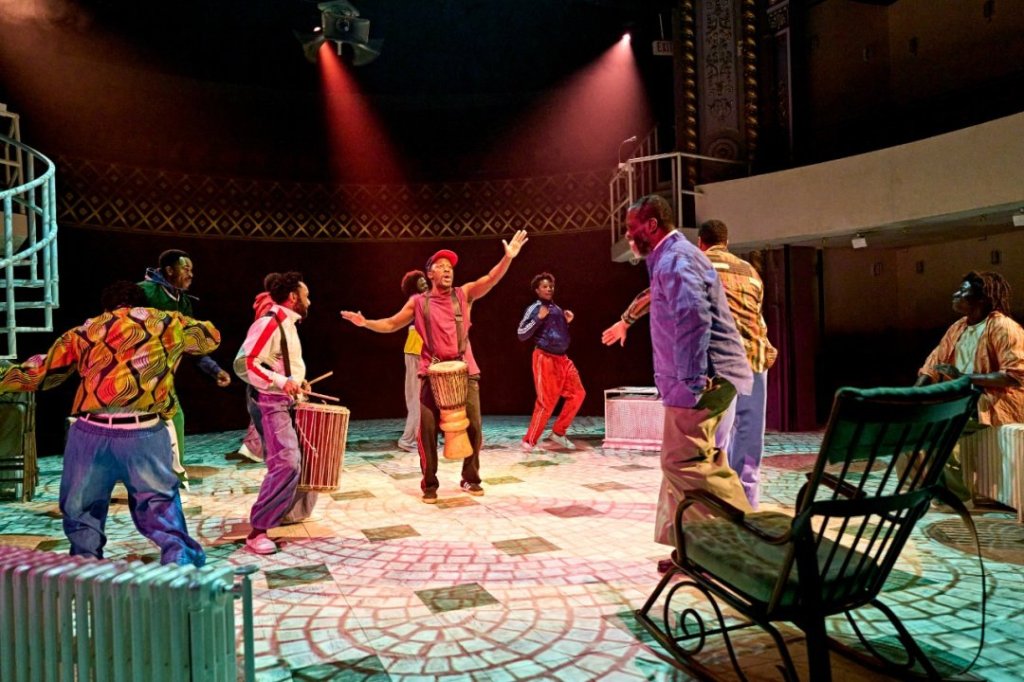
Additionally, while the lighting was striking, the same siren like effects were used for both emergency alarms and scene changes, which was initially confusing.
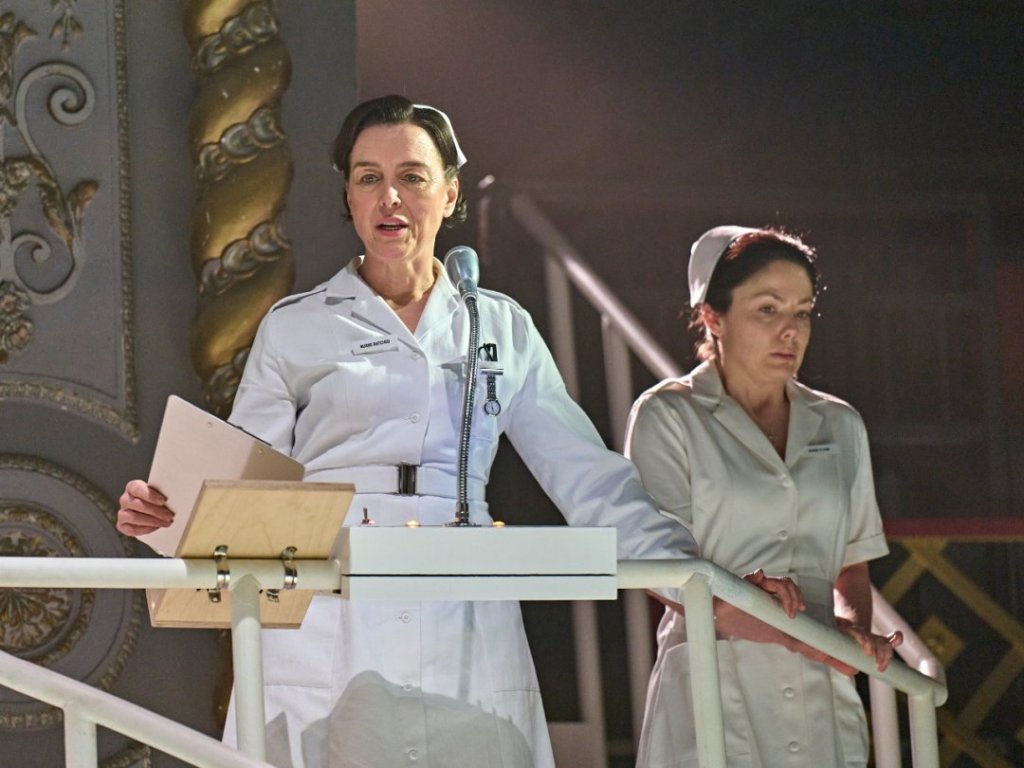
It also worth remembering that this is a historic text. Both the nurses and the sex workers felt a little one dimensional. As well as their cruel decisions, I would have loved the production to lean more into the fear they may well have had in an institution where they were outnumbered by male patients larger than them – but this, of course, is not in the source material.
The finale sees the stage torn up to reveal soil, a desolate image that returns to the play’s concern with Indigenous land loss and the displacement of Native voices. While this kind of stagecraft has become increasingly familiar in London theatre this season, it remains an effective conclusion to this particular story.
Clint Dyer’s production foregrounds the power dynamics of the ward while placing Indigenous land loss at its emotional centre.
RUNNING TIME:
Approximately two hours 40 minutes, including a 20-minute interval
AGE GUIDANCE: 14+
Haze, smoke, onstage smoking (herbal cigarette), flashing lights, theatrical blood, the use of prop firearms and needles, gunshot sound effects and spark effects.
- 1817 – Official Designation: Congo Square is named the only legal Sunday gathering spot in New Orleans for the enslaved to preserve their music and dance.
- 1856 – Cultural Suppression: New laws ban the use of drums and horns in the square, tightening systemic control over expression.
- 1938 – ECT Invented: Neurologists Cerletti and Bini perform the first “shock therapy” treatment in Rome.
- 1962 – Novel Published: Ken Kesey releases One Flew Over the Cuckoo’s Nest, drawing on his time working in a psychiatric ward.
- 1975 – Film Release: The famous film adaptation starring Jack Nicholson is released, focusing on the struggle against institutional authority.
- 2026 – Old Vic Revival: Director Clint Dyer introduces the history of Congo Square to the story, connecting the characters to a wider legacy of displacement.
Latest reviews:
- Review: Here Comes J. Edgar!, King’s Head Theatre ★★★★

- Review: Abigail’s Party, Richmond Theatre (and on tour) ★★★★
- Review: Avenue Q, Shaftesbury Theatre ★★★★

- Review: Local, Finborough Theatre ★★★

- Review: Tender, Bush Theatre ★★★½

- Review: To Kill a Mockingbird, Wyndham’s Theatre ★★★★

- Review: Archduke, Royal Court ★★★

- Review: Last Goal Wins, Broadway Theatre, Catford, ★★★★½

- Review: Kinky Boots, London Coliseum ★★★½

- Review: Relics, Lyric Hammersmith ★★★★

- Review: Rayuela: Compañía Marco Flores, Sadler’s Wells East ★★★★

- Review: Lost the Plot, Omnibus Theatre, Clapham ★★★★

 Red Bus Londinium Life