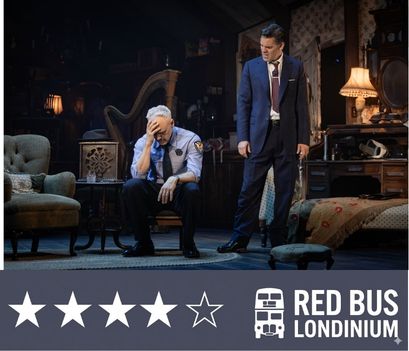
Arthur Miller knew: every choice has its price
There is a dread that comes with knowing one day you will have to enter a dead parent’s home to divide up their belongings. Arthur Miller knew it. He wrote The Price in the aftermath of his own father’s death, and its emotional intelligence about what happens when siblings are forced to reckon, without a parent as referee, with a shared past they remember entirely differently, is as sharp and unsparing as anything in his canon.
For anyone over 50, this play is less an evening of theatre than an appointment with something you have been quietly dreading. The insight at its heart is that two people can grow up in the same house, with the same parents, and leave carrying entirely irreconcilable versions of events well into middle age, as both weapon and wound. It lands not as drama but as recognition.
Jon Bausor‘s set announces its intentions immediately. The stage is deep, attic-dark, light filtering from covered windows onto furniture shrouded in dust sheets. The vague shapes of a harp, a chaise longue, the accumulated weight of a life. The unsettling opening music sets a tension that doesn’t fully lift. This is a space full of memories and the sounds of a family that has gone quiet.
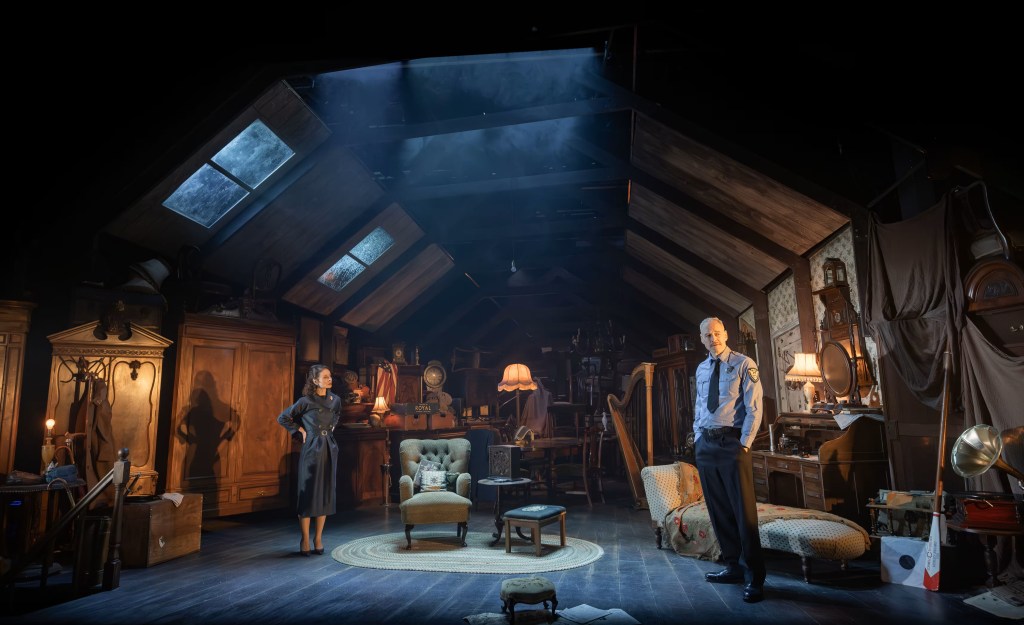
Into it steps Elliot Cowan’s Victor, a straight-laced cop carrying decades of resentment as quietly as a man carries a stone in his shoe. He gave up college to nurse his father after the Wall Street Crash while his brother Walter, tall, blond, tailored, the understated American Dream made flesh, walked away and became a surgeon. Victor has spent his life measuring himself against that choice, and Cowan’s performance is a masterclass in dignified resignation. The desperation seeps through the veneer.
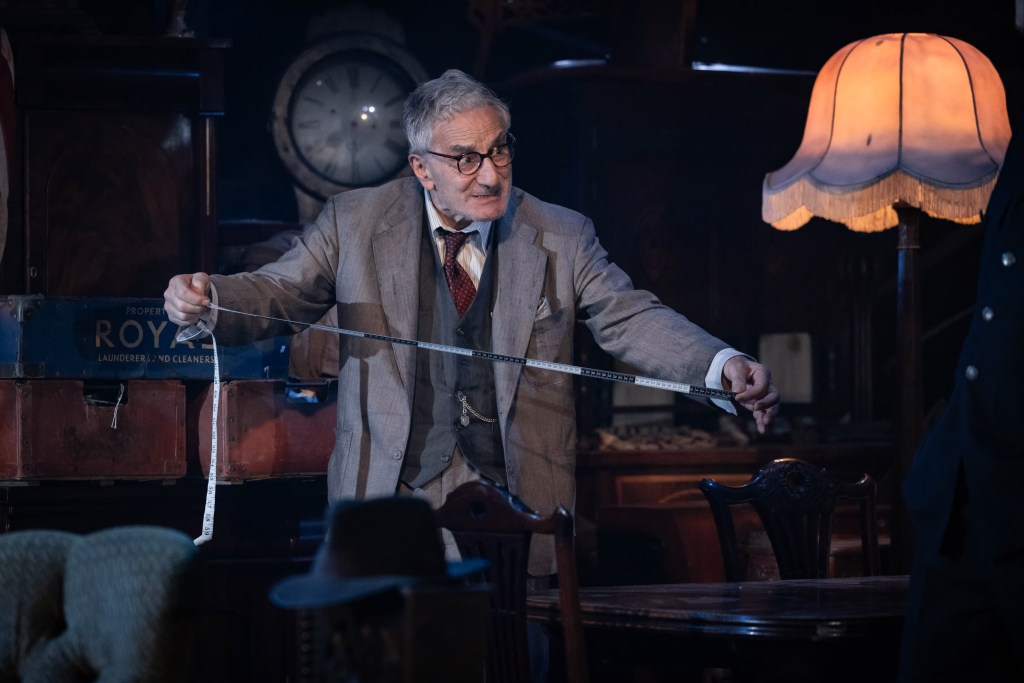
Then there is Henry Goodman‘s Gregory Solomon, and the evening changes entirely. Ostensibly retired, he cannot resist one more deal. He charms, teases, touches his cheek, ducks and dives, pretends to be vulnerable whenever Victor blusters, and in doing so leads Victor expertly to a probably less than lucrative agreement. Goodman is electrifying: physically specific, mordantly funny, a man who has made his own peace with the price of everything and finds himself vastly more at ease with it than anyone else on stage.
The interval twist sees Walter arrive just as the deal is struck, pivoting the play from dark comedy into something rawer and harder. John Hopkins‘ Walter is slick, articulate, and quietly corroded by guilt. His olive branches feel as much like attempts at self-absolution as generosity, and Miller is wise enough never to resolve who is right. Faye Castelow as Esther holds her own in a role that risks being thankless, bringing grounded intelligence to a character who could easily be reduced to little more than the wife whose frustrations keep the brothers honest.
If the production has a weakness, it is the second half, which tips into a succession of slightly too long monologues arriving one after another. The emotional confrontation Miller has been building towards loses some of its force through sheer length. Where the play should coil and strike, it occasionally unspools. This is not Miller at his absolute peak. But it is a Miller who is nakedly personal, and under Jonathan Munby‘s careful direction the performances carry it through.
The Marylebone Theatre, three years old and already quietly essential, has assembled something genuinely special. Go before it closes on 7 June and if you are of an age where parents’ belongings and siblings’ long memories are starting to feel less like abstract drama and more like a calendar appointment, you may find it hits closer to home than you expected.
For anyone over 50, this play is less an evening of theatre than an appointment with something you have been quietly dreading.
All photos: Mark Senior
Latest reviews:
- Review: Hot Pot, Playhouse East ★★★★

- Review: Glengarry Glen Ross, Old Vic ★★★

- Review: Shantify, Underbelly Boulevard, Soho ★★★½

- Review: Before I’m Dead, The Glitch ★★★★

- Review: Mass, Donmar Warehouse ★★★★

- Review: The Boy Who Harnessed the Wind, @sohoplace ★★★★

- Review: Shawshank Redemption, Richmond ★★★½

- Review: The P Word, Bush Theatre ★★★★½

- Review: Mother Courage and Her Children, Shakespeare’s Globe ★★★★

- Review: Planet Omar, Unicorn Theatre ★★★★

- Review: The Harder They Come, Theatre Royal Stratford East ★★★★

- Review: 1536, Ambassadors Theatre ★★★★

 Red Bus Londinium Life