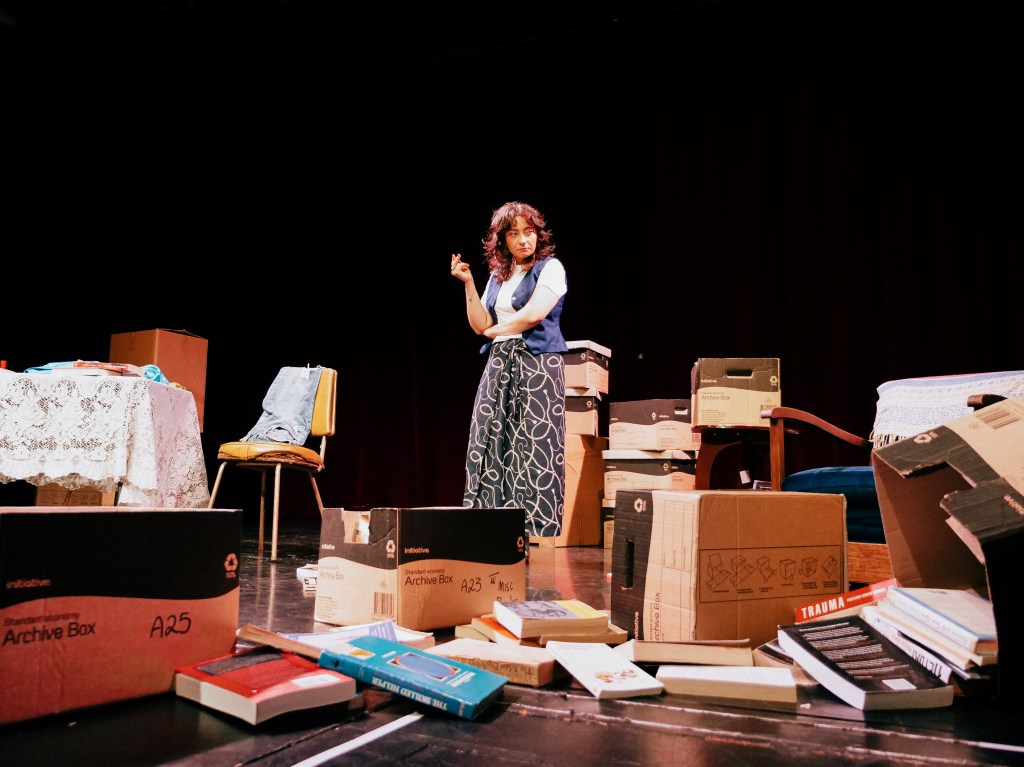
Photo credit: Mayah Salter
The award-winning solo show asking what we owe to the stories we never quite received
After sweeping up awards at the Melbourne, Adelaide and Edinburgh Fringes, including the prestigious Scotsman Fringe First, NIUSIA has arrived in the UK in both Brighton and London. This one-woman show, written and performed by Beth Paterson, tells the story of her grandmother Niusia, a Holocaust survivor whose past was rarely spoken about. Beth pieces together inherited fragments of memory, navigating the silences that echo across generations and discovering something unexpected about herself along the way.
Ahead of the London run, Beth Paterson sat down to answer questions about the responsibility of inherited memory, the universal experience of family silence, and why humour is not just welcome in a show about the Holocaust, but isessential. Whether or not the Holocaust is part of your family history, NIUSIA speaks to the strange weight of not quite knowing where they come from.
Red Bus: As living memories of the Holocaust begin to fade, how do you feel the role of the grandchild shifts from being a listener to becoming a vital, active guardian of history?

Beth Patterson: I think there’s a profound shift happening as we move from living memory into inherited memory. My grandmother could testify to what happened because she lived it. My generation can’t do that. What we inherit instead is the responsibility to carry fragments forward — stories, gestures, fears, humour, recipes, contradictions — and to keep them alive in a way that remains human rather than purely historical.
For me, the role of the grandchild is not to become a perfect historian or a replacement witness. It’s to become an active custodian of memory: to ask questions, to preserve nuance, and to resist the flattening that happens when history becomes abstract or symbolic. The Holocaust can sometimes be spoken about in numbers and enormity, but family stories return it to individual people — to someone’s mother, someone’s daughter, someone who loved music or argued at the dinner table or survived impossible things.
What I’ve found through creating NIUSIA is that inheritance is rarely neat. You don’t receive a complete narrative. You inherit fragments, absences, emotional residue, and unanswered questions. Part of being a grandchild is learning to live alongside those gaps while still refusing disappearance. In that sense, remembrance becomes active rather than passive.
I also think grandchildren occupy a unique position because we are far enough away to ask difficult questions, but still close enough to feel the emotional consequences of what was endured. That creates the possibility for works like NIUSIA — works that are deeply personal, but that also invite broader audiences into conversations about memory, displacement, survival, and intergenerational inheritance.
As living witnesses become fewer, storytelling becomes even more important. Not to fossilise history, but to keep it emotionally alive, relational, and urgently connected to the present.
Red Bus: For audience members facing their own family silences, what do you hope they take away from Beth’s courage in digging beneath memories to find tenderness and truth?
Beth Patterson:The starting point of NIUSIA is not knowing. Not knowing is a universal experience, and one that is often shrouded in shame: shouldn’t I know more about this? Through NIUSIA, I navigate this uncomfortable starting point. Rather than self-flagellation for not knowing, I became interested in interrogating why I knew so little in the first place.
What I discovered is that the family silence emerged as a consequence of assimilation and simply wanting to leave the pain in the past. You do not have to be a descendant of the Holocaust for this to feel relatable. From there, I dive into the discovery with a hearty dose of humour and curiosity.
I hope audiences take that curiosity and self-compassion with them. If you find yourself facing enormous, seemingly impenetrable family silences, I hope you can hold them tenderly.
Red Bus: Kat Yates mentioned the common experience of “not knowing” amongst children of immigrants. Did focusing on the specific fragments of Niusia’s life help make the broader themes of identity feel more accessible for everyone?
Beth Patterson: Kat Yates has been part of NIUSIA from day one and, more than simply directing the work, has been a genuine co-creator of it. One of the most important things she brought into the process was the role of the audience advocate: someone constantly asking questions about the fragments of family history, ritual, language, and memory that I had taken for granted.
Early on, I didn’t actually think my Jewishness was central to the story. I would bring Kat scenes or anecdotes and she’d stop and ask, “Can you explain this to me?” and I’d suddenly realise that things I assumed were universal were actually deeply culturally specific. That repeated experience of translation — of having to articulate something half-known, inherited, or fragmented — became central to the work itself.
I think that’s where the broader themes of identity became accessible. Rather than trying to make the story universal by broadening it, we did the opposite: we became more precise. We focused on the small fragments of Niusia’s life, the gaps in knowledge, the inherited silences, the strange feeling of simultaneously knowing so much and so little about where you come from. Those specifics opened up conversations that audiences from many different backgrounds seem to recognise in themselves.
While NIUSIA is deeply rooted in Jewish diaspora experience, it also touches something broader about inheritance and belonging — particularly for children and grandchildren of immigrants, refugees, or displaced people. That feeling of “not knowing enough,” of being disconnected from parts of your own history, is incredibly common. Kat’s questions helped us shape the work in a way that warmly invites audiences into that experience, rather than assuming prior knowledge.
Red Bus: How important is the show’s “sharp Jewish humour” in helping an audience confront horrific memories while still celebrating the survival and love that allows a family to continue?
Beth Patterson: Humour is key to NIUSIA. It’s a show that travels to dark places. However, Kat and I made the decision that we were not interested in creating a work that abandoned audiences inside despair: we did not want to traumatise our audiences. Instead, we made a work that celebrates survival, family, and connection to culture.
Humour gives the audience space to breathe — to laugh their way through the inevitable pain of a work that centres on the Holocaust. It also speaks to the profound role laughter plays in survival.
In the show, I recount a memory of my mother’s: as a child, she and Niusia were on holiday together. Niusia let out this huge booming laugh that echoed through the accommodation, and a woman stumbled in and recognised her from their time together in the camps. What does that tell you? You’ve gotta laugh.
Red Bus: Having toured from Melbourne to Edinburgh, and now arriving in Brighton and London, have you found that different audiences respond to Beth’s universal journey in ways that have surprised you?
Beth Patterson: Meeting audience members after the show — especially during Fringe seasons — is my favourite part of touring. When I emerge to greet people, audience members are so often still in that hazy emotional land, and being able to witness and hold them in that fragile, thoughts-not-yet-fully-formed state is incredibly special.
Audience members — young and old, Aussie, Greek, Jewish, Italian, Indigenous, Middle Eastern — all speak to me about what it means to be unable to speak the language of their forebears. People speak to me and I see them yearning to sit their children or parents down to tend to that familial and cultural connection: to hear and receive stories, to laugh and cry and roll their eyes.
I am rarely surprised by these reactions. More than anything, I feel deeply privileged to be able to hold up a mirror in which people can see themselves.
NIUSIA continues at Theatre503 in Battersea until 23rd May 2026.
RUNNING TIME: 60 minutes (no interval)
AGE GUIDANCE: 14+
References to Violence, War, Antisemitism, Concentration Camps, War
Crimes, and Genocide; Depiction Of A PTSD Flashback; Descriptions Of
Concentration Camp Experiences; Reference To and Depiction of a
Hate Symbol.
Like this article? Please stay around to read my reviews:
- Review: Love’s Labour’s Lost & Much Ado About Nothing, OT on the Hill ★★★★½

- Review: Republic of Silence, Riverside Studios ★★★½
- Review: The Truth, Apollo Theatre ★★★★

- Review: Cleansed, Almeida ★★★★
- Camden Fringe Review: This App Is a Haunted House ★★½

- Camden Fringe Review: Bathroom, Etcetera Theatre ★★★½
- Review: Matthew Bourne’s The Car Man, Sadler’s Wells ★★★★★

- Review: Dark of the Moon, Charing Cross Theatre ★★★

- Camden Fringe Review: Asian Pirate Musical, Upstairs at the Gatehouse ★★★½
- Review: The Importance of Being Oscar, Park Theatre ★★★★

- Camden Fringe Review: 1918: The Final Salome, Etcetera Theatre ★★½
- Review: Cyrano de Bergerac, Noël Coward Theatre ★★★★½

 Red Bus Londinium Life