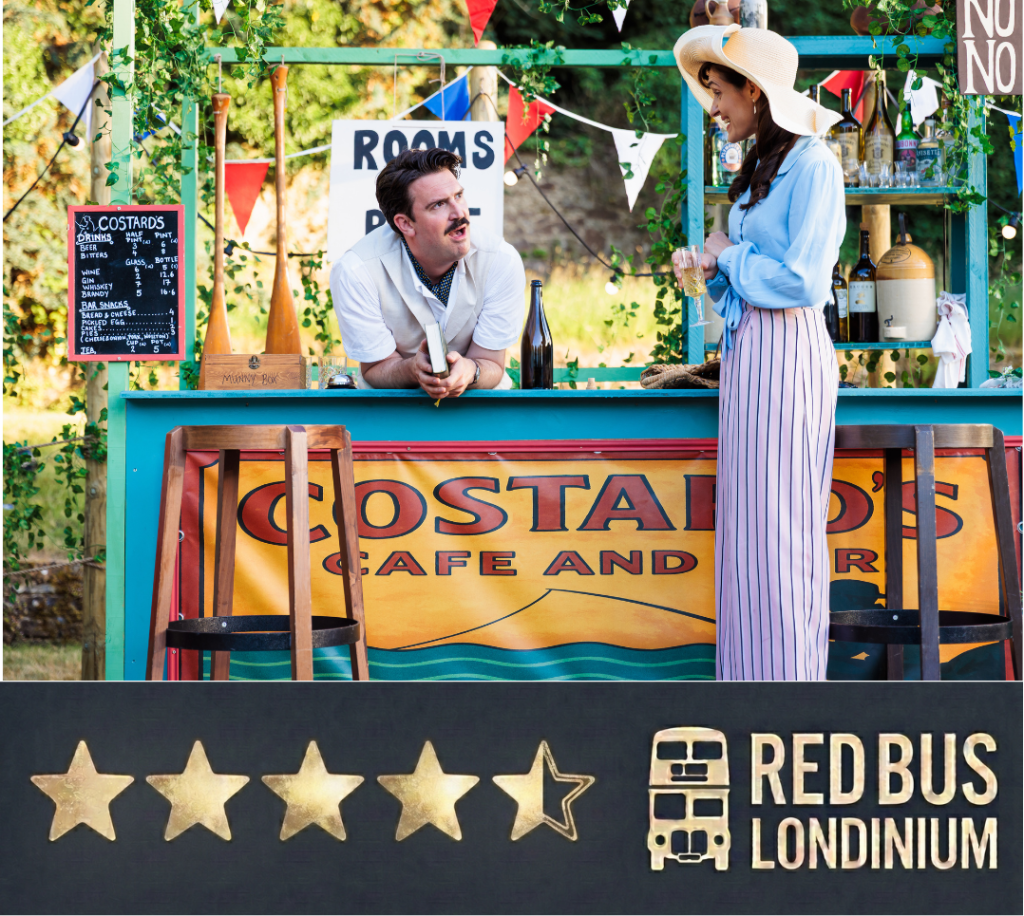
A delightful outdoor double bill
It is testament to the accomplishment of this co-production between the Guildford Shakespeare Company and the Orange Tree Theatre, currently staged at OT on the Hill (Thomas’s College), that five hours of Shakespeare pass so joyfully. There was not a moment in this double bill where the pace lagged.
Though there has long been speculation that Much Ado About Nothing might in fact be the lost Love’s Labour’s Won, it is a tantalising theory that remains unresolved. Here, the idea is accepted and it treated as a sequel. Love’s Labour’s Lost is set just before World War II and Much Ado About Nothing just after. The stitching of the plays together works well and makes for a pleasant afternoon and evening in a delightful setting.
Many characters now continue across the two plays. Berowne from the first play and Benedick from the second play are combined into Benedick Berowne, played by James Sheldon. Lord Longaville and Don John become John Longaville; Dumain and Claudio are Claudio Dumain. The Princess of France takes on the role and functions of Don Leonato from the second, under the name Leonata. Hero, Beatrice and Margaret keep the same names in both though the actors for Hero and Margaret double in other roles in this ten-part ensemble.
This segue into war worked for me. War explains the gruffness between Beatrice and Benedick when they come back in Much Ado About Nothing. All of them are more sombre; they have grown, matured, seen difficult things. The over-the-top vows to ignore women and sleep have gone, and more measured men remain, though the women have been left ready for a bit of scheming of their own. Perhaps they need some playfulness after the war?
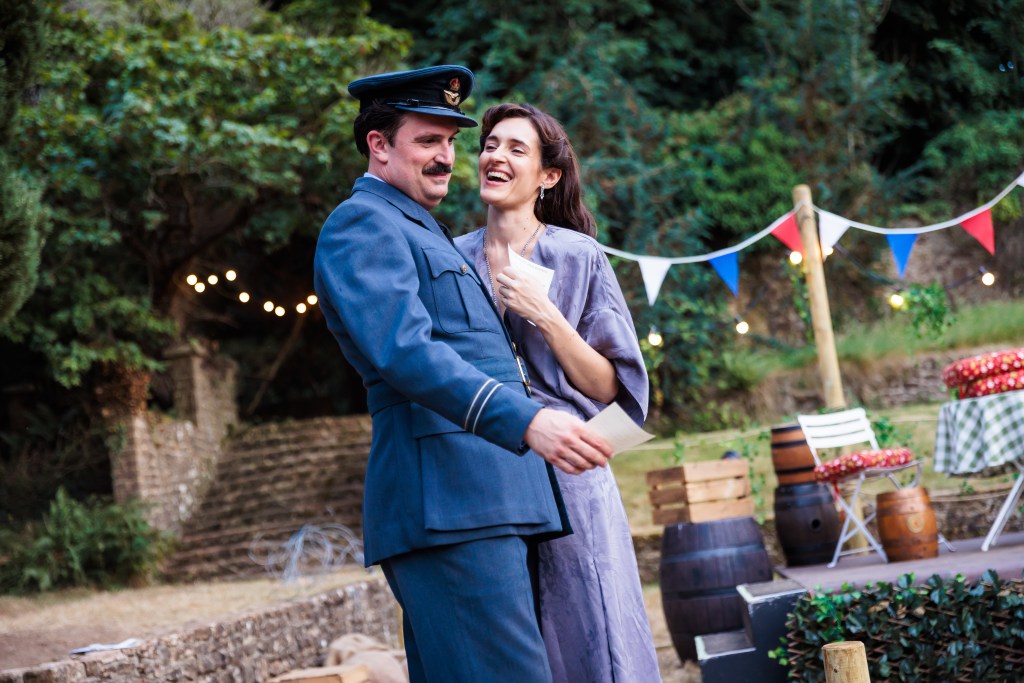
The set, designed by Neil Irish, shows its war scars too. The colourful riverside bar, with its streamers of bunting, outdoor swing, boats and comfy tables, is closed and all the furniture overturned as we come back for our second show. The unwrapping and tidying of the set by the cast becomes a potent image of them beginning to rebuild their lives.
All the Guildford Shakespeare Company players project their voices with impressive clarity. Their outdoor projection was strong enough that not a word was dropped.
Blocking and movement are a particular strength, with the whole grounds used. As the audience watches a scene on stage, glimpses of characters hand-in-hand in the distance add to a sense of place and continuity. The landscape is used to great effect; for example, Benedick hides in a tree, with the shaking of a branch providing an additional moment of humour. This is especially impressive given that the production has already transferred from Guildford Shakespeare Company’s usual home at Braboeuf Manor, meaning the staging has had to work across two very different venues.
Tom Littler also has a sharp eye for composition. Every scene, and seemingly every moment within it, feels carefully arranged, with each actor’s position and shape purposeful without ever seeming contrived. At one moment the cast are gathered around the bar, at another bunched together on the floor or scattered among the seats, with Benedick hiding in a boat, someone perched on a swing and another character at a table. This constant movement and rearrangement makes the play feel as though events are unfolding naturally in front of us, rather than being blocked into fixed positions. Yet for all the visual dynamism, the actors’ projection is never compromised.
James Sheldon‘s comedic timing and physical humour are exceptional, at times side-splittingly funny. He has a wonderful rapport with the audience and can make it feel as though he is having a self-deprecating conversation with them. His slapstick is well-paced and impressively brave, culminating in a soaring flight behind a hedge. Peering behind the scenes at the interval revealed a large gym mat, which perhaps explains how he survives it. More than this, though, Sheldon makes Shakespeare’s language feel fresh and immediate. He is perhaps the member of the cast most adept at drawing out the emotional life of every sentence, finding both the comedy and the feeling within the language.
Beatrice’s own hiding scene, which follows Benedick’s tree escapades, inevitably suffers by comparison. It’s a hard act to follow, and though Phoebe Pryce plays it well, nothing here could match the sight of Sheldon disappearing into the branches
If I had one hesitation in a production of such quality, it is that some moments could sustain a little more emotional complexity. Claudio’s anger might also reveal more of his devastation, while Leonata’s determination to make Claudio pay for what he’s done to her daughter could carry greater menace. These are small reservations, but there were moments when I found myself wanting just a little more from the darker emotions in the text.
Music and soundscape underline the era and mood effectively (Matthew Floyd Jones and Matt Eaton). Here too, entrances have been considered. In grounds the size of Thomas’s College, entrances can be long, and suitable music to accompany these makes them part of the action rather than a pause. Helicopter, church bells and car sounds were very authentic, and more than once I saw audience members peering skywards or looking for a steeple. Small sound effects added to the humour in some of the funnier scenes as well.
Songs sung by the cast worked well, and the Owl and the Cuckoo song at the end of Love’s Labour’s Lost, as the characters clearly headed into World War II, was achingly melancholic.
Dance too is imaginatively and playfully used. The disguised Russians dance in Cossack style with real verve and legs flying. In the party scenes in Much Ado About Nothing, the music repeating as smaller duos and trios converse reminds us that it is all still the same party.
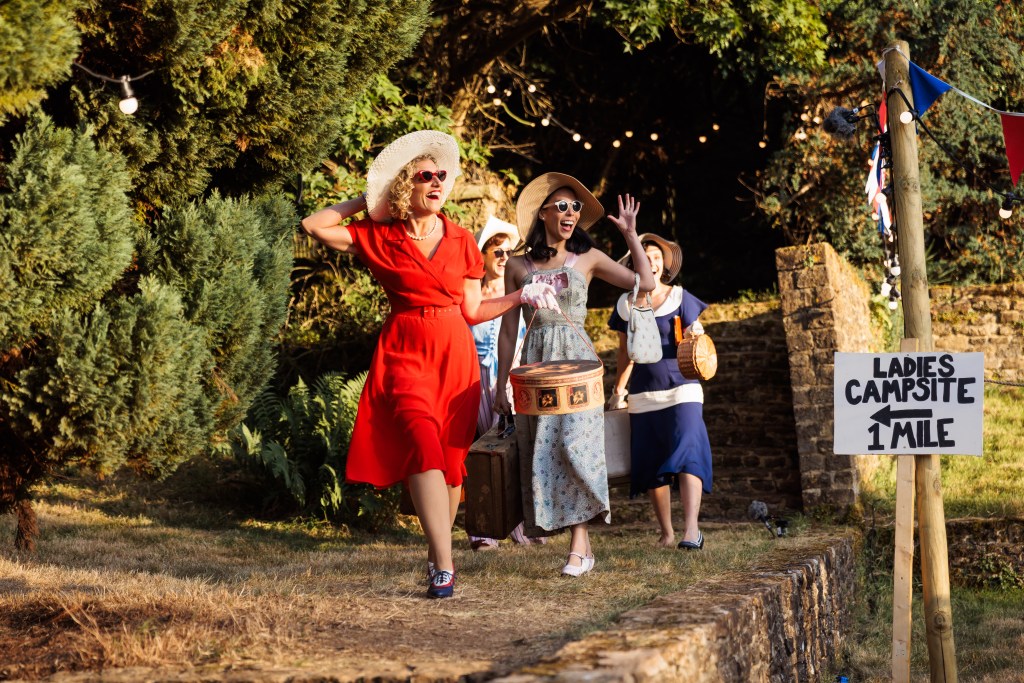
Neil Irish has thought of every detail. Hat pins, earrings, feathers are all here. Costume changes come thick and fast within each show, a dress, necklace and gloves all swapped in moments, yet nothing feels rushed or slapdash. The whole thing is meticulously detailed and authentic to the time periods.
What makes this double bill particularly satisfying is that it feels like more than two Shakespeare plays placed side by side. The decision to treat Much Ado About Nothing as a sequel to Love’s Labour’s Lost works well, with war providing the dividing line between youthful certainty and the more complicated world that follows. The care in the staging, movement, music, costumes and performances makes the whole experience feel remarkably cohesive.
The company has found a convincing way to make these familiar plays feel connected and newly alive, while the setting at OT on the Hill provides an expansive playground in which the ensemble can really flourish.
Five hours of Shakespeare is a considerable commitment, but this is a double bill that earns its length. As the sun fades and the story plays out, we are grateful for the time we have had in the company of these characters.
Photography by Harry Elletson
Recent reviews:
- Review: Love’s Labour’s Lost & Much Ado About Nothing, OT on the Hill ★★★★½

- Review: Republic of Silence, Riverside Studios ★★★½

- Review: The Truth, Apollo Theatre ★★★★

- Review: Cleansed, Almeida ★★★★
- Camden Fringe Review: This App Is a Haunted House ★★½

- Camden Fringe Review: Bathroom, Etcetera Theatre ★★★½
- Review: Matthew Bourne’s The Car Man, Sadler’s Wells ★★★★★

- Review: Dark of the Moon, Charing Cross Theatre ★★★

- Camden Fringe Review: Asian Pirate Musical, Upstairs at the Gatehouse ★★★½

- Review: The Importance of Being Oscar, Park Theatre ★★★★

- Camden Fringe Review: 1918: The Final Salome, Etcetera Theatre ★★½

- Review: Cyrano de Bergerac, Noël Coward Theatre ★★★★½

Subscribe to get our content straight to your inbox:
 Red Bus Londinium Life