Mass: A distance and terrible puzzle, presented up Close
Can a parent love a child who committed a crime? Should they? And, if they try to stop, what is left? These are the questions that Fran Kranz’s drama places very quietly at the centre of a room and dares its four characters (and the audience) to sit with. Mass, a film before this world premiere stage adaptation directed by Carrie Cracknell, comes with more questions than answers.
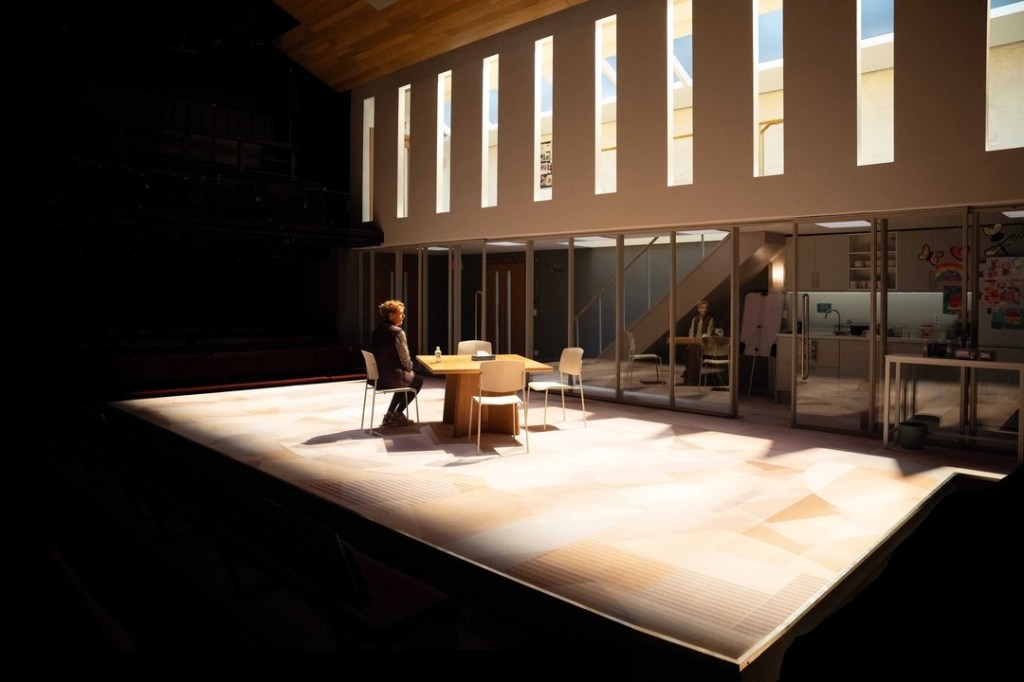
The set-up is almost corporate in its simplicity. A small room in an Episcopal church, rendered by designer Anna Yates in calm pastels: institutionally neutral, deliberately so. Two couples meet to have a conversation no parent should ever have to face. Gail (Lyndsey Marshal) and Jay (Adeel Akhtar) lost their son Evan in a school shooting; Richard (Paul Hilton) and Linda (Monica Dolan) are the parents of Hayden, the boy who killed him. Six years have passed. It is, in every sense, the worst meeting anyone has ever had to attend.
For a British audience, the premise carries a cultural weight that is largely not our own. This is a horror we have only experienced once. Dunblane is a scar on the country’s soul but there was decisive action. Thirty years on, the legislation that followed the murder of sixteen primary school children and their teacher remains some of the tightest gun control in the world. That a country could, time and again, experience its equivalent and have nothing change is, from the outside, a distressing but distant puzzle. Mass does not explain it to us. Instead, it places us inside the grief of those who must live within it and asks us to stay there.
Even before the four central figures arrive, there is a build up of nervous energy. The play is book-ended by the church volunteers preparing the room: rearranging chairs, debating where to put the tissues, setting out too much food and then quietly removing some of it. Their small, fussing actions carry everything the play is about to attempt. They are ill-prepared, they are trying their best and they care deeply. By the time the two couples finally sit down, we are already in the same state of discombobulation that they are.
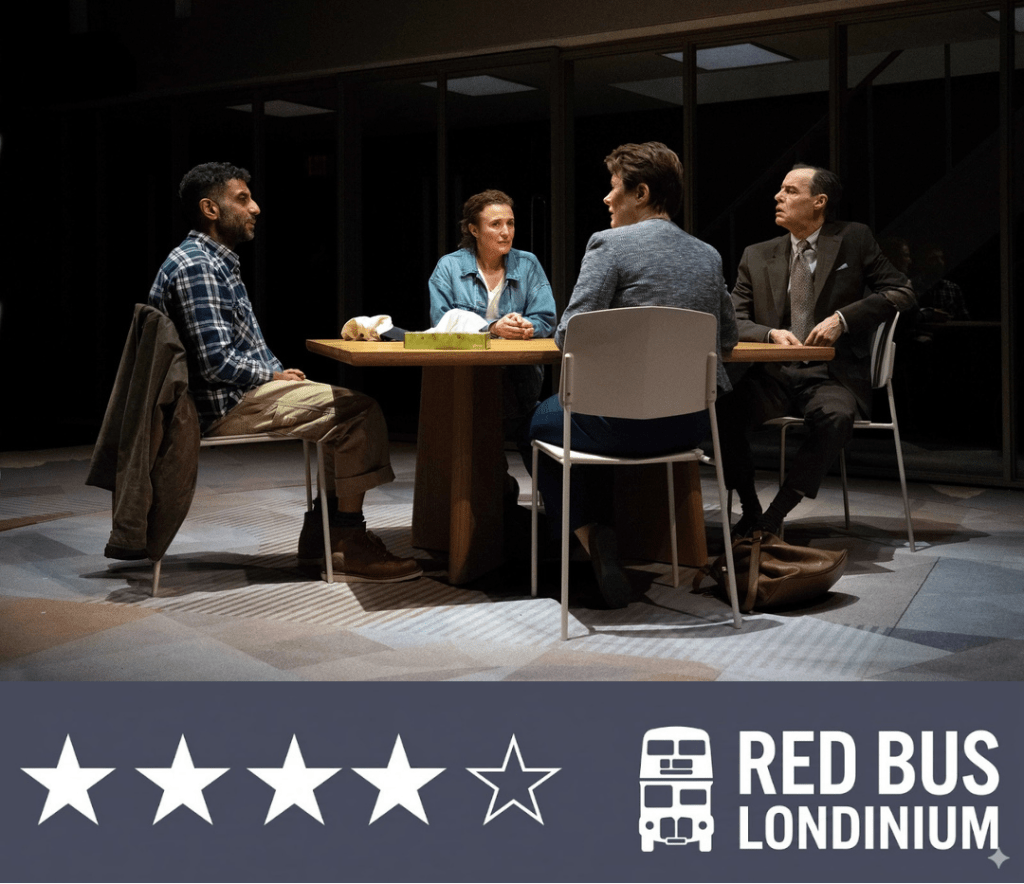
The divide between the two families is visible before anyone speaks. Richard’s suit and pocket handkerchief against Jay’s jeans. It is not laboured, but it is there: a shorthand for the political landscape the two families inhabit, the America they have each internalised as normal. Richard’s conservatism against Jay’s more liberal anti-gun zeal.
Each of the four showed their distress in their own ways. Paul Hilton’s Richard is angular throughout, the body of a man who would look up, twist, turn away to give himself respite from the intimacy of the group’s pain. Monica Dolan’s Linda leans forward across the table with the kind of determined physicality that suggests she has rehearsed being present even when everything in her wants to flee.
Lyndsey Marshal as Gail angles her chair fractionally away from the table, a detail so small you might miss it, but which tells us that this is someone still not quite sure she should be in this room at all.
Adeel Akhtar’s Jay carries a different complication. His son Evan was killed, but some of the public narrative that grew around his death was false. Jay has had to live inside a story that isn’t quite true, and the weight of that mismatch sits on him throughout.
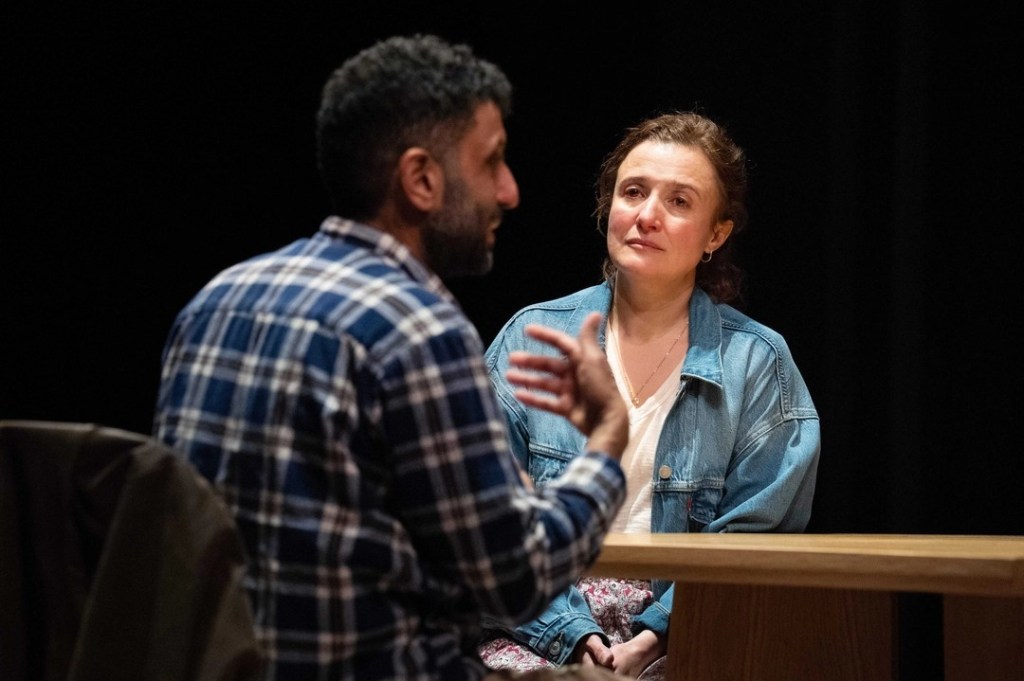
The question the play keeps pressing on is how much Hayden’s social isolation should mitigate anything. His parents had been relieved when he finally found friends, relieved enough to overlook what those friendships actually involved: gun ranges, unsuitable games. The desire to see your child belong is not a small thing but how much does it excuse? The play doesn’t say, we are left to grapple with this for ourselves.
This is a slow, quiet play. It asks you to sit in the silence between speeches and some of that silence is genuinely hard. Occasionally the emotional returns feel marginally smaller than the investment might promise and the choir music that closes the evening is perhaps a touch too saccharine for where the play has been. But these are small reservations about a production that does what theatre at its best is supposed to do: it takes lives you cannot directly know and helps you see them from within. That it does not answer any questions may frustrate some but then a look across the pond will remind us that gun control and high school shootings are not a problem that looks like being solved any time soon.
The desire to see your child belong is not a small thing. But how much does it excuse?
All images: Richard Hubert Smith
Latest reviews:
- Review: Monarchs Anonymous, The Other Palace ★★½

- Review: Barnum, Richmond Theatre ★★★½

- Review: Driftwood, Kiln Theatre ★★★

- Review: Hot Pot, Playhouse East ★★★★

- Review: Glengarry Glen Ross, Old Vic ★★★
- Review: Shantify, Underbelly Boulevard, Soho ★★★½

- Review: Before I’m Dead, The Glitch ★★★★
- Review: Mass, Donmar Warehouse ★★★★
- Review: The Boy Who Harnessed the Wind, @sohoplace ★★★★

- Review: Shawshank Redemption, Richmond ★★★½
- Review: The P Word, Bush Theatre ★★★★½
- Review: Mother Courage and Her Children, Shakespeare’s Globe ★★★★

 Red Bus Londinium Life