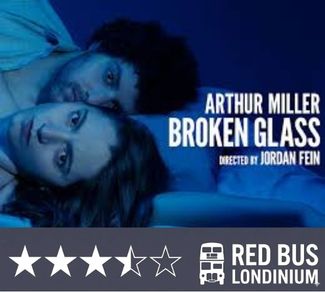
Review: Broken Glass, Young Vic
In the late 1930s, Brooklyn was a borough defined by its striving immigrant spirit, yet for the Jewish families living there, a chilling wind was blowing in from Europe. Arthur Miller’s 1994 play, Broken Glass, currently revived at the Young Vic, captures this specific moment of historical dread through the collapse of a single marriage. We follow Sylvia Gellburg, a woman who suddenly finds herself unable to walk after reading accounts of Kristallnacht, the “Night of Broken Glass,” in Nazi Germany.
The Young Vic is a space that consistently champions theatre as a tool for empathy, reflecting voices that deserve to be heard. Director Jordan Fein’s production is visually distinct, opting for a stage entirely covered in carpet. This choice creates a muffled, stifling atmosphere, perhaps echoing the way the characters try to dampen the noise of the outside world. Amidst this softness sits a bowl with two live goldfish. Their presence is a beautiful nod to Miller’s own philosophy that “the fish is in the water and the water is in the fish.” It suggests that we are inseparable from our environment; Sylvia cannot simply “get better” when the very world she inhabits is becoming poisoned by hatred.
However, even with such a thoughtful foundation, some elements of the production feel slightly out of alignment. A significant hurdle is the age of the lead actors. The Gellburgs are played by performers who appear much too young for the roles. The script relies on the weight of a long, tired marriage and the specific anxieties of middle age in 1938. Without that visible history of years spent together, the friction between Phillip and Sylvia loses some of its lived-in complexity.
The production also struggles to maintain its grip on the audience’s attention over its duration. The pacing feels uneven, with several stretches in the first act where the momentum stalls. This was unfortunately reflected in the auditorium where bright lighting directed over the audience revealed several patrons who had drifted off to sleep. Lighting this audience activity pulled focus away from the delicate human drama on stage and made it difficult to stay immersed in Sylvia’s internal struggle.
What remains undeniably powerful, however, is the play’s exploration of what we choose to ignore. The characters’ ability to look away from distant atrocities feels incredibly timely. Miller reminds us that looking away is a choice, one with its own heavy price.
Ultimately, this is a production that approaches a difficult subject with a measured and respectful hand. While the casting and technical choices have their flaws, the core of the play remains an insightful look at identity and the cost of denial. It is a reminder that theatre can be a vital lesson in human connection, provided we are willing to keep our eyes open.
- 1938 (October): Germany mandates that all Jewish passports be marked with a red ‘J’. (In the play, Sylvia Gellburg begins to see reports of these escalating persecutions in the newspapers.)
- 1938 (November 9–10): Kristallnacht (The Night of Broken Glass) occurs across Germany and Austria. Over 7,000 Jewish businesses are destroyed and 30,000 Jewish men are sent to concentration camps.
- 1938 (November): The Setting: A Brooklyn bedroom. Sylvia Gellburg suddenly loses the use of her legs as the news from Europe filters into her home.
- 1940s–1950s: Arthur Miller establishes himself as America’s premier playwright with Death of a Salesman and The Crucible, often exploring the collision of private guilt and public responsibility.
- 1994: Broken Glass premieres at the Booth Theatre on Broadway. Miller is 78 years old and the play is hailed as a major “late-career” masterpiece.
- 1995: The production moves to the National Theatre in London and wins the Laurence Olivier Award for Best New Play.
- 2011: A major West End revival at the Vaudeville Theatre reinforces the play’s status as a staple of modern psychological drama.
- 2026: The Young Vic presents this new production directed by Jordan Fein, marking a return to the theatre’s long and fruitful history with Miller’s work.
DISCOUNT TICKETS AT THE YOUNG VIC:
Read my guide to young person tickets at the Young Vic. They also offer cheap “Lucky Dip” tickets for those who book early.
RUNNING TIME: 1 Hour 50 minutes with no interval
AGE GUIDANCE: No official Guidance, Red Bus suggests 16+
Racism (particularly antisemitism and references to Nazism), Sexism, Ableism and discriminatory attitudes to disability, Sexual content (including descriptions of sexual assault), Reference to mental and physical health (including characters collapsing onstage), Smoking, Heart Attack
- Review: Heart Wall, Bush Theatre *** ½
- Review: Broken Glass, Young Vic *** ½
- Review: Flyby, Southwark Playhouse **½

- Review, Hoopla! 20th Anniversary, *****

- Review: Lifeline, Southwark Playhouse ***

- Review: Lighthouse, Courtyard Theatre *** ½

- Review: John Proctor Is A Villain, Royal Court ****
- Review: A Mirrored Monet, Charing Cross Theatre **
- Review, Yentl, Marylebone Theatre, ****
- Review: Welcome to Pemfort, Soho Theatre ****
- Review: Waitress Musical, New Wimbledon Theatre *****
- Review: Choir Boy, Stratford East ****


 Red Bus Londinium Life
Leave a comment