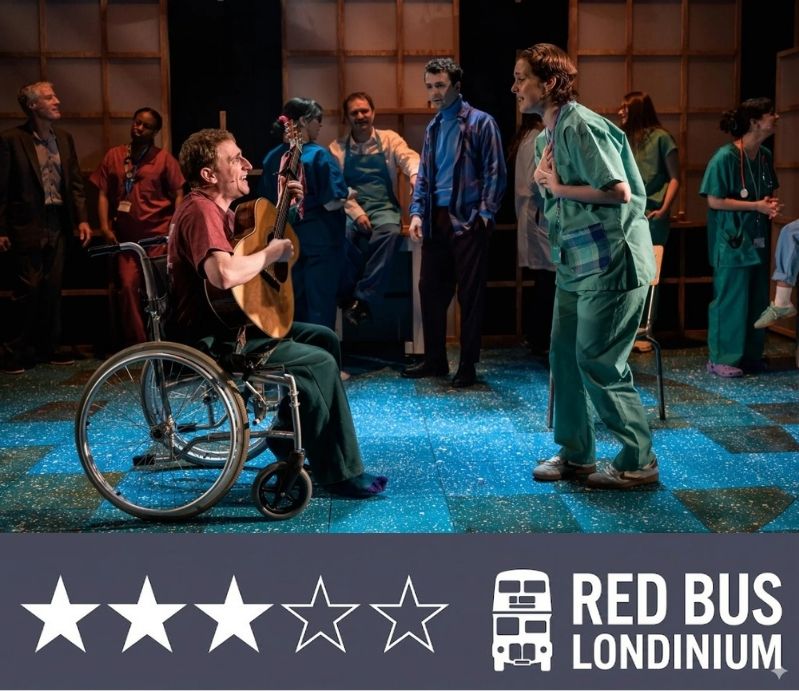
Photo credit: Charlie Flint
Review: Lifeline, Southwark Playhouse Elephant
The story of penicillin is often told in broad strokes: a fortunate accident in a London laboratory that changed the course of human history. In Lifeline, a new musical at the Southwark Playhouse Elephant, this history is given a melodic pulse, intertwining the life of Alexander Fleming with a contemporary narrative about the burgeoning crisis of antibiotic resistance. It is a production of immense heart and unimpeachable morals, even if the storytelling occasionally loses its way in its own ambition.
At the centre of the historical thread is Fleming himself, portrayed with a compelling sense of mission. We see him shaped by his harrowing experiences during the Great War, driven by a visceral need to find a way to save lives that would otherwise be lost to simple infections. These sequences are where the show finds its gravity. However, the production spends a great deal of time exploring his romantic life, which, while performed with charm, feels like a distraction from the urgent core of his scientific quest.
Parallel to this is the modern story of Jess, a doctor dealing with the terrifying reality of a world where our miracle drugs are failing. Her personal struggle, involving a partner facing a life threatening infection that refuses to respond to treatment, is moving and deeply relevant. Yet, here the narrative feels overstuffed. We spend a significant amount of time on a sub-plot involving Samira, a child patient whose recovery and farewell party are sweetly rendered but ultimately unnecessary to prove that penicillin is a marvel.
Similarly, while a sequence featuring the mother of Jess’s partner packing up a house was brilliantly performed, it contributed to a sense that the piece was over-extended. One cannot help but feel that the production might have been even more impactful as a taut, one act drama. By focusing more tightly on Jess’s modern crisis and Fleming’s wartime catalyst, the emotional stakes would have remained sharp rather than being diffused across various backstories and pop concert sub-plots.
Despite these structural quibbles, there is much to admire. The staging is frequently clever, making excellent use of the space to bridge the decades. The music is truly glorious, infused with a wonderful Scottish flair that pays homage to Fleming’s roots and adds a unique, folk-driven texture to the score. This is a work of global significance, evidenced by the fact that portions of the play have been performed at the United Nations.
Perhaps the most poignant moment comes at the very end. The production features real NHS staff as extras, and we hear live, authentic testimony from these healthcare professionals. It is a sobering, beautiful reminder that theatre is at its best when it reflects the voices of our real life heroes.
Ultimately, Lifeline is a show that wears its five star intentions on its sleeve. While the execution occasionally falters under the weight of its plotlines, its spirit is undeniable. It serves as an insightful lesson in both our past and our precarious future. If even one person in each audience leaves the theatre with a renewed respect for the use of antibiotics, then this production will have done its vital job. It is a pleasurable, necessary reminder that the miracles of the past require our protection today.
Lifeline runs at Southwark Playhouse Elephant until 11 May.
- 1914–1918: The Catalyst. Alexander Fleming serves in the Royal Army Medical Corps during WWI. Witnessing soldiers die of sepsis from infected wounds fuels his lifelong obsession with finding a “miracle” antiseptic.
- 1928: The Accident. Fleming famously leaves a petri dish of Staphylococcus unattended in his London lab. He returns to find a “mould” (Penicillium) has killed the bacteria, the birth of the first antibiotic.
- 1945: The Warning. Fleming wins the Nobel Prize. In his acceptance speech, he issues a chillingly prophetic warning: that public “misuse” of the drug could lead to bacteria becoming resistant.
- 1953: The Love Story. A grieving, widowed Fleming marries his colleague, the brilliant Greek scientist and resistance fighter Amalia Voureka, just two years before his death.
- 2018: The Seed. Composer Robin Hiley and Becky Hope-Palmer begin developing the musical (originally titled The Mould That Changed the World) to raise awareness about Antimicrobial Resistance (AMR).
- 2024: The Global Stage. The production makes history as the first musical ever performed at the United Nations General Assembly in New York.
- 2026: The London Premiere. Lifeline opens at Southwark Playhouse Elephant, featuring a rotating chorus of real-life NHS staff alongside its professional cast
Recent reviews:
- Review: Lifeline, Southwark Playhouse ***

- Review: Lighthouse, Courtyard Theatre *** ½

- Review: John Proctor Is A Villain, Royal Court ****

- Review: A Mirrored Monet, Charing Cross Theatre **
- Review, Yentl, Marylebone Theatre, ****

- Review: Welcome to Pemfort, Soho Theatre ****

- Review: Waitress Musical, New Wimbledon Theatre *****
- Review: Choir Boy, Stratford East ****

- Review: Squidge, Riverside Studios ****

- Review: Summer Folk, National Theatre **** ½

- Review: Ancient Grease, The VAULTS ***

- Review: Mythos: Ragnarök, Alexandra Palace ****

Southwark Playhouse reviews:
- Review: Before After, Southwark Playhouse ***
- Review: Berlusconi a new musical, Southwark Playhouse ***
- Review: Blanket Ban, Southwark Playhouse ***
- Review: Children of the Night, Southwark Playhouse ****
- Review: Kenrex, Southwark Playhouse ****½
- Review: Lifeline, Southwark Playhouse ***
- Review: Scissorhandz, Southwark Playhouse ***

 Red Bus Londinium Life
Leave a comment