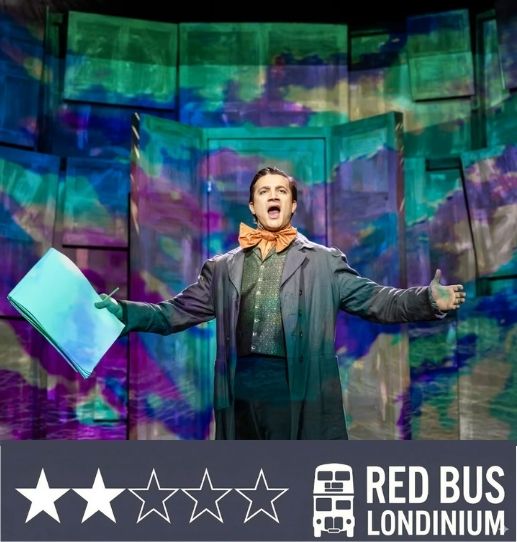
Photo credit: Pamela Raith
Review:A Mirrored Monet at Charing Cross Theatre – Light, Loss and Legacy
It is always a pleasure to step into the Charing Cross Theatre. The unique Arches atmosphere, with the occasional low rumble of trains passing overhead, often adds a welcome layer of realism to the productions held there. In A Mirrored Monet, this auditory quirk feels particularly immersive, echoing the drums of war described during the 1916 scenes as a world hangs in the balance.
The production is visually arresting, thanks to Matt Powell’s projections which transform the stage into a living canvas. The transitions between 1860s Paris and 1916 Giverny are handled with grace, and the realism of the Salon des Beaux Arts is especially evocative. Libby Todd’s costume designs further anchor the piece in the Belle Époque; seeing Brooke Bazarian’s Camille struggling with the restrictive silhouette of a bustle even as her health declines is a moving testament to the era’s rigid social expectations.
However, for a musical centred on a man who revolutionised how we perceive light and colour, the script occasionally feels surprisingly monochromatic. Jeff Shankley delivers a powerful performance as the elder Monet, quivering with a palpable sense of rage and regret. Likewise, Dean John-Wilson captures the hunger of the younger artist. Yet, both actors are hemmed in by a book that focuses heavily on Monet’s flaws without fully illuminating his visionary spark or the joy he found in his craft. We see the arguments and the ego, but we miss the magnetic north that drew friends like Renoir and Pissarro to him.
The songs are well performed, but the lyrics at times lean into simpler rhymes that lack the Impressionist fluidity one might expect from the subject matter. During the Salon des Beaux Arts sequence, one found oneself wishing for the sharp, rapid-fire wit found in something like the Embassy Lament from Chess. That song famously uses clever, background-rich lyrics, (debriefed, debugged, de-drugged, disarmed), to ground the audience in its setting, a technique that, used here, could have helped explain exactly why the establishment found Impressionism so radical.
The movement was truly revolutionary. By painting en plein air to capture the transient effects of light, these artists were essentially inventing a new way of seeing that rejected the high finish of academic tradition. Historically, this circle was defined by a radical, “us against the world”, generosity. In their early years, Monet and Renoir survived on potatoes they grew themselves. At other times, Renoir brought bread from his parents’ house just so Monet’s family would not starve.
Ultimately, A Mirrored Monet is a handsome production that offers a clear window into the deprivation of wartime France. While it may leave some searching for the light that made Monet a master, it remains an insightful look at the heavy cost of an obsessive commitment to art. For those familiar with the history, it is a sturdy companion piece; for newcomers, it serves as a starting point to discover the man behind the waterlilies.
- 1863: The Rejection. The official Paris Salon jury rejects two-thirds of the submitted works, including those by Manet and Pissarro. In response, Emperor Napoleon III sanctions the Salon des Refusés, where Manet’s Le Déjeuner sur l’herbe causes a public scandal. While Monet did not exhibit here, the event marked the beginning of the end for the Salon’s absolute authority.
- 1867: The Refusal. Monet submits two works to the official Salon, including Women in the Garden, but both are refused. This ongoing exclusion by the establishment fuels the group’s radical decision to eventually form their own independent exhibitions.
- 1870: A City of Fog. Following the outbreak of the Franco-Prussian War, Monet moves to London in September to avoid conscription. He settles in Kensington with his wife Camille and their young son. It is during this time that he becomes captivated by the London fog and begins to study the works of Constable and Turner at the National Gallery, influences that would forever change his approach to light
- 1870: A Heavy Loss. While Monet is safe in London, his close friend and fellow artist Frédéric Bazille (who had often supported Monet financially) joins the infantry. Bazille is killed in action at the Battle of Beaune-la-Rolande on 28 November 1870, a devastating blow to the close-knit circle of artists.
- 1883: The Sanctuary. Claude Monet moves to Giverny. He begins the decades-long process of transforming his garden into a living canvas, diverting a local river to create his famous lily pond.
- 1883: The Sanctuary. Claude Monet moves to Giverny. He begins the decades-long process of transforming his garden into a living canvas, diverting a local river to create his famous lily pond.
- 1899: The First Lily. Monet begins his first series of Nymphéas (Water Lilies). At this stage, the light is clear, the blues are vibrant, and the world is in sharp focus.
- 1912: The Blurred Vision. Monet is diagnosed with nuclear cataracts in both eyes. His palette begins to shift; unable to see the subtle violets and blues, his paintings take on the muddy reds and yellows that define his later “distorted” style.
- 1923: The Mirror. After years of hesitation and fear of blindness, Monet undergoes risky cataract surgery. He begins to see in ultraviolet light, perceiving the world with a “mirrored” or ghostly blue tint that influences his final masterpieces.
- 1926: The Final Brushstroke. Monet passes away at Giverny. Shortly after, his massive Orangerie murals, known as the “Sistine Chapel of Impressionism”, are opened to the public as a symbol of peace following WWI.
- Today: The Reflection. A Mirrored Monet debuts in London
A Mirrored Monet continues at Charing Cross theatre until 9 May.
RUNNING TIME: 2hrs 30mins including interval
AGE GUIDANCE: 12+
Latest reviews:
- Review: A Mirrored Monet, Charing Cross Theatre **

- Review, Yentl, Marylebone Theatre, ****
- Review: Welcome to Pemfort, Soho Theatre ****
- Review: Waitress Musical, New Wimbledon Theatre *****

- Review: Choir Boy, Stratford East ****

- Review: Squidge, Riverside Studios ****

- Review: Summer Folk, National Theatre **** ½

- Review: Ancient Grease, The VAULTS ***

- Review: Mythos: Ragnarök, Alexandra Palace ****

- Review: Children of the Night, Southwark Playhouse ****

- Review: Iron Fantasy, Soho Theatre *** ½

- Review: Russell Maliphant Dance Company Landscapes, Sadlers Wells East ****

Charing Cross Theatre reviews:
- Bronco Billy, Charing Cross Theatre ***

- Review: A Mirrored Monet, Charing Cross Theatre **
- Review: Mrs President, Charing Cross Theatre **


 Red Bus Londinium Life
Leave a comment