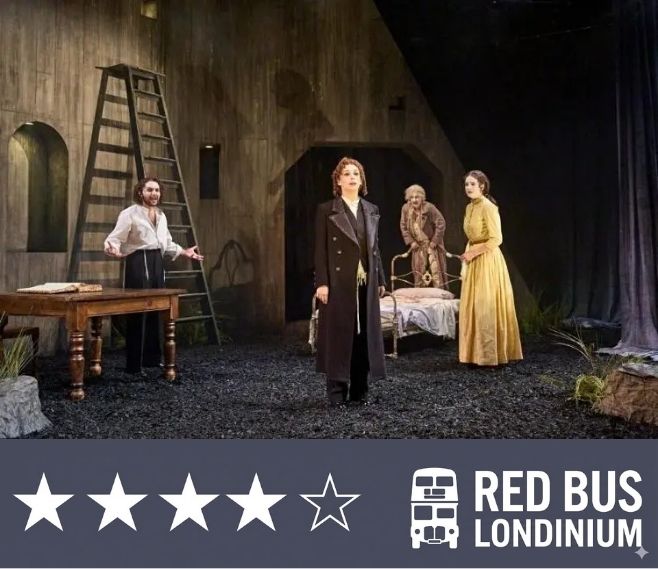
Review: Yentl, Marylebone theatre
A century of Yiddish soul arrives in London, reclaiming Singer’s gritty masterpiece from the ghosts of Hollywood’s past.
Based on a short story by Isaac Bashevis Singer, this adaptation of Yentl arrives at the Marylebone Theatre with a rare seal of authenticity. Unlike the 1983 Barbra Streisand film, which Singer famously detested as a piece of ego, this production carries the explicit blessing of the author’s grandchildren. It stays truer to his gritty and intellectually fierce roots, reclaiming a narrative that explores the boundaries of gender and faith through a distinctly Yiddish lens.
Performed in English and Yiddish, with surtitles projected onto the exterior wall of a drab grey house, this otherwise striking production comes courtesy of the Kadimah Yiddish Theatre in Melbourne. The English is lightly peppered with Jewish terms such as yeshiva (a religious school) and mikvah (the ritual bath), prompting some audience members to quietly check meanings with their neighbours. It is a small reminder that the cultural texture here is not being smoothed over for easy export. The definition of the latter is particularly vital; if the audience does not grasp that the mikvah requires total nakedness for ritual purity, they may miss the sheer peril Yentl faces when navigating these gendered spaces.
While this production originally premiered in Melbourne in 2022 and enjoyed a prize winning season at the Sydney Opera House in 2024, it has now arrived in London for its first trip abroad. The tour marks a century since the Kadimah first established itself as a hub for independent Yiddish performance in Australia. It is a significant milestone for a company reviving a culture many had more or less filed under “lost.”
Kadimah’s artistic director Evelyn Krape and lead actor Amy Hack have both travelled with the production to London, reprising the roles they originated in Australia. Krape commands the stage with impish authority, somewhere between Arlecchino and Puck. She narrates the protagonist’s inner tug of war between the Jewish Yetzer Ha-Ra (the self-centred inclination) and the Yetzer Ha-Tov (the altruistic inclination), relishing both the mischief and the mounting chaos.
Hack delivers a powerful performance as the titular character, while Ashley Margolis provides equally strong work as the yeshiva student Avigdor. Played with a palpable sense of pain, Margolis’s portrayal gives the production much of its emotional weight.
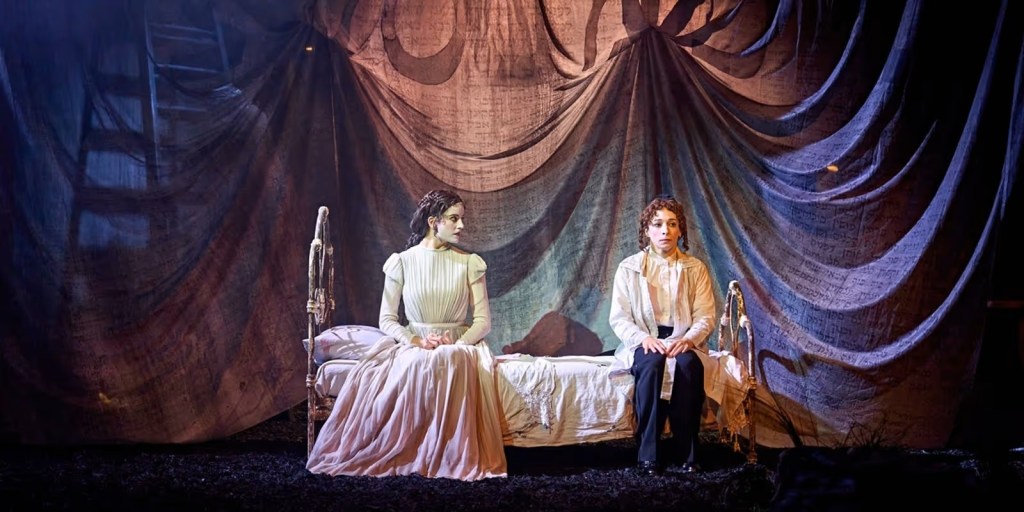
The play’s true power lies in its refusal to offer simple answers to the questions of identity it raises, remaining remarkably faithful to Singer’s original prose. Yentl’s yearning to learn is presented as a radical act of spiritual survival in a world where she feels the weight of a cosmic error. As Singer wrote, Yentl possessed “the soul of a man and the body of a woman,” and her desire to learn in a woman’s body showed that “even Heaven makes mistakes.” This perceived divine error drives Yentl toward increasingly radical and dishonest choices, as masquerading as a man becomes her only path to the Torah.
While the production mirrors the story’s intellectual depth, it makes the underlying sexuality more overt, bringing to the surface the physical desire that Singer’s text often only suggests. By leaning into the rigid social laws of the shtetl, the production highlights the devastating friction between the soul’s infinite desires and the body’s finite constraints. It is a story where the stakes are deeply theological, showing how Yentl’s pursuit of truth forces her into a web of deception that inevitably hurts those she holds most dear.
- Late 1800s: The Setting: a strictly traditional Polish shtetl. The story is rooted in the rigid gender divide of Orthodox Judaism.
- 1962: Isaac Bashevis Singer publishes “Yentl the Yeshiva Boy.”
- 1975: Adapted for Broadway by Leah Napolin and Singer himself.
- 1978: Singer wins the Nobel prize.
- 1983: Barbra Streisand directs and stars in the musical film. She receives a scathing review from Singer.
- 2022: Kadimah Yiddish Theatre (Melbourne) creates a new bilingual script.
- 2023: The production moves to the Sydney Opera House, winning multiple Green Room Awards.
- 2026: Opens at the Marylebone Theatre in London.
Although set in history, Yentl feels startlingly contemporary, especially in our current climate where the rigidity of religious thinking in many faiths seeks to push the rights of women backwards. Guided by a cheeky narrator and anchored by palpable pain, this Yentl is a triumphant act of cultural revival.
Latest reviews:
- Review: A Mirrored Monet, Charing Cross Theatre **
- Review, Yentl, Marylebone Theatre, ****

- Review: Welcome to Pemfort, Soho Theatre ****

- Review: Waitress Musical, New Wimbledon Theatre *****

- Review: Choir Boy, Stratford East ****
- Review: Squidge, Riverside Studios ****

- Review: Summer Folk, National Theatre **** ½

- Review: Ancient Grease, The VAULTS ***

- Review: Mythos: Ragnarök, Alexandra Palace ****

- Review: Children of the Night, Southwark Playhouse ****

- Review: Iron Fantasy, Soho Theatre *** ½

- Review: Russell Maliphant Dance Company Landscapes, Sadlers Wells East ****


 Red Bus Londinium Life
Leave a comment