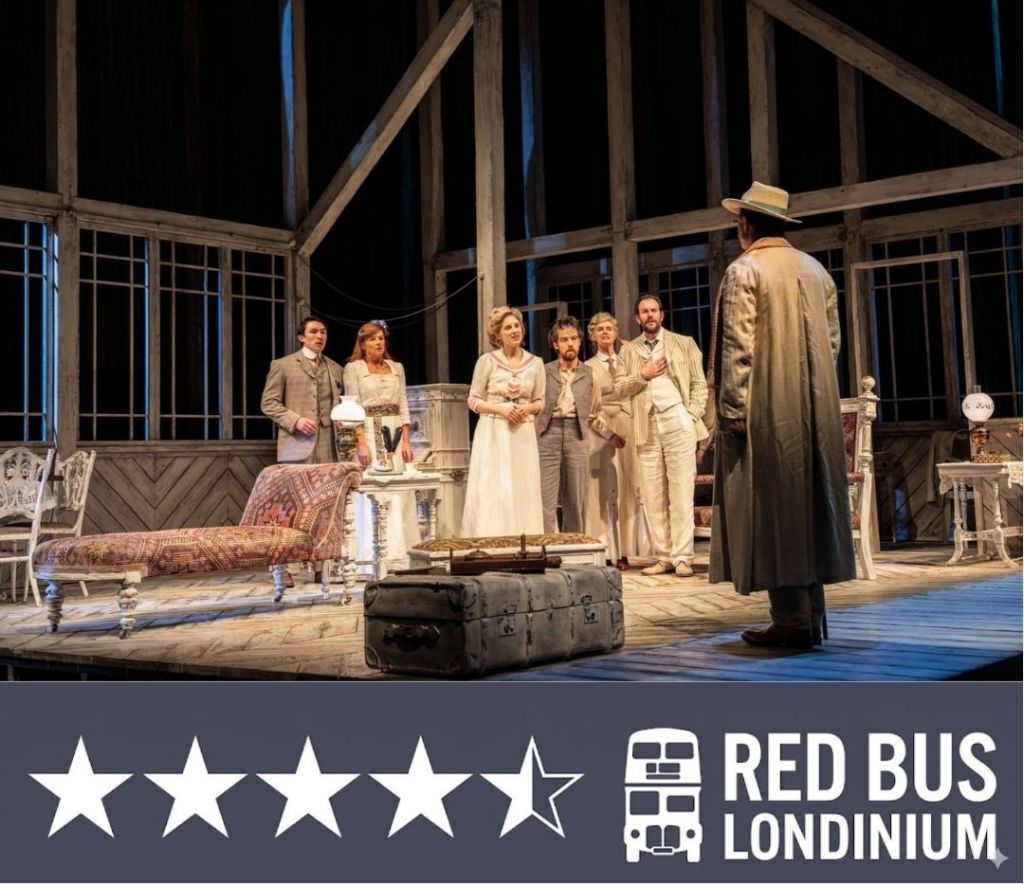
Review: Summerfolk, National Theatre (Olivier)
There is something inherently revitalising about seeing the Olivier stage used to its full potential. In an era where minimalist casts are often the necessity, Robert Hastie’s production of Summerfolk feels like a rare and decadent treat. A full cast, a massive landscape, and a story that breathes: it is exactly what our National Theatre should be doing.
Maxim Gorky’s 1905 play is a razor-sharp portrait of the dacha classes. These are the rich, idle, and fundamentally unfulfilled professionals who retreated to the countryside to sip champagne while the world outside began to burn. In 1905, Russia was on the brink of its first revolution, making this play’s atmosphere of oblivious privilege even more pointed. Gorky was writing about people who were quite literally dancing on a volcano.
As I sat in the stalls, I could not help but think: is 1905 really that far away? In our current age of Kardashians and lifestyle vloggers, have we really changed? We might have swapped the piano playing and fishing for green smoothies and yoga, but the “ennui” remains the same.
At the heart of this storm are the two leads, Paul Ready as Bassov and Sophie Rundle as Varvara. Their relationship is the epiotome of domestic alienation. For those who know Ready as the lovable Kevin from Motherland, his performance here is a revelation. He plays Bassov as a magnificent, sleazy clown: a bumbling lawyer with a paper-thin ego who is totally oblivious to the fact that his wife can barely stand to be in the same room as him. Meanwhile, Sophie Rundle is luminous as the disillusioned Varvara. Her quiet, desperate need to escape this hollow life makes the eventual climax feel earned and powerful. The cast are uniformly talented across the board, but this central pairing really brings the human cost of the era to life.
The beauty of this production is that the characters feel enormously real. Like a great Russian novel (I remember having to draw myself complex family tree diagrams just to get through Anna Karenina), there is a large, interrelated cast to keep track of. However, here the relationships are crystal clear. There are Russian names, of course, but blessedly fewer patronymics to trip one up.
The set design by Peter McKintosh is a masterstroke. It uses the full depth of the Olivier stage and the wings to create a 3D sense of a landscape that feels both vast and claustrophobic. Accompanying this is atmospheric, traditional-sounding music composed by Nicola T. Chang and played by Adrian Zalotuhun, which grounds the play firmly in its time and place.
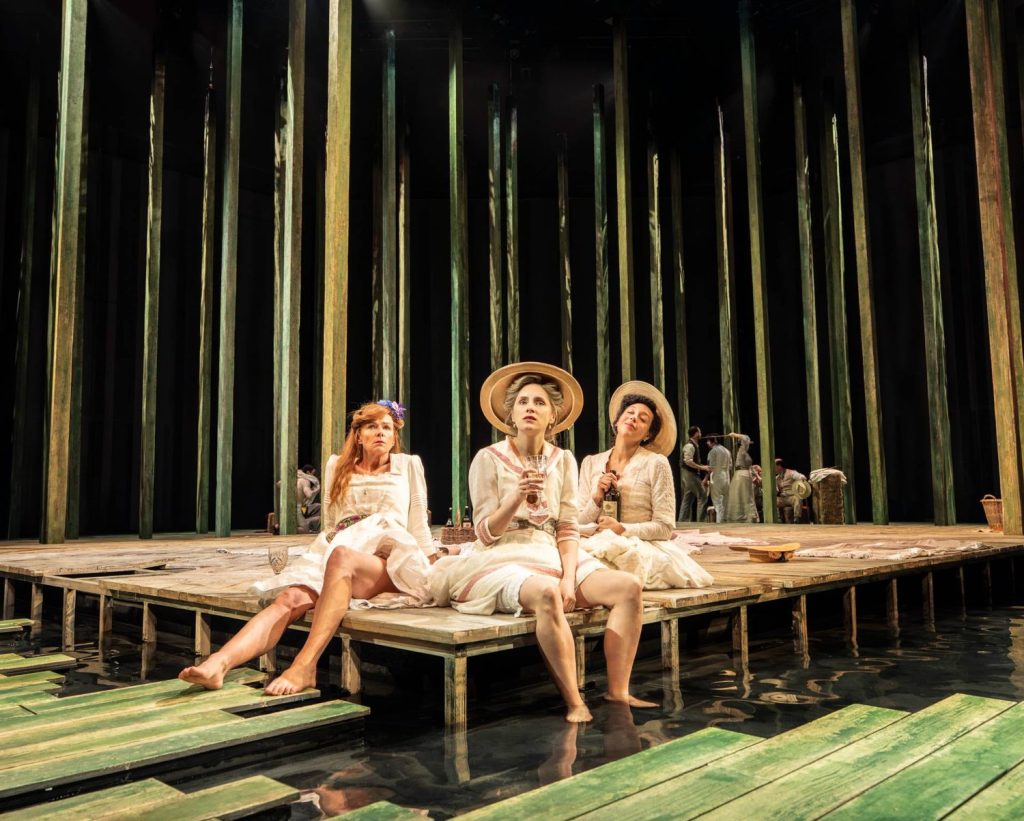
Perhaps the most heartening thing of all was seeing the auditorium full of young people. This is the National at its best: taking a heavyweight play from the past and presenting it so vibrantly that a new generation can see its relevance for their own lives. Three hours might seem like it should be challenging, but the time whipped by.
A sprawling and satirical summer treat, playing at the National Theatre, you have until 29 April 2026 to catch it.
Latest reviews:

 Red Bus Londinium Life
Leave a comment