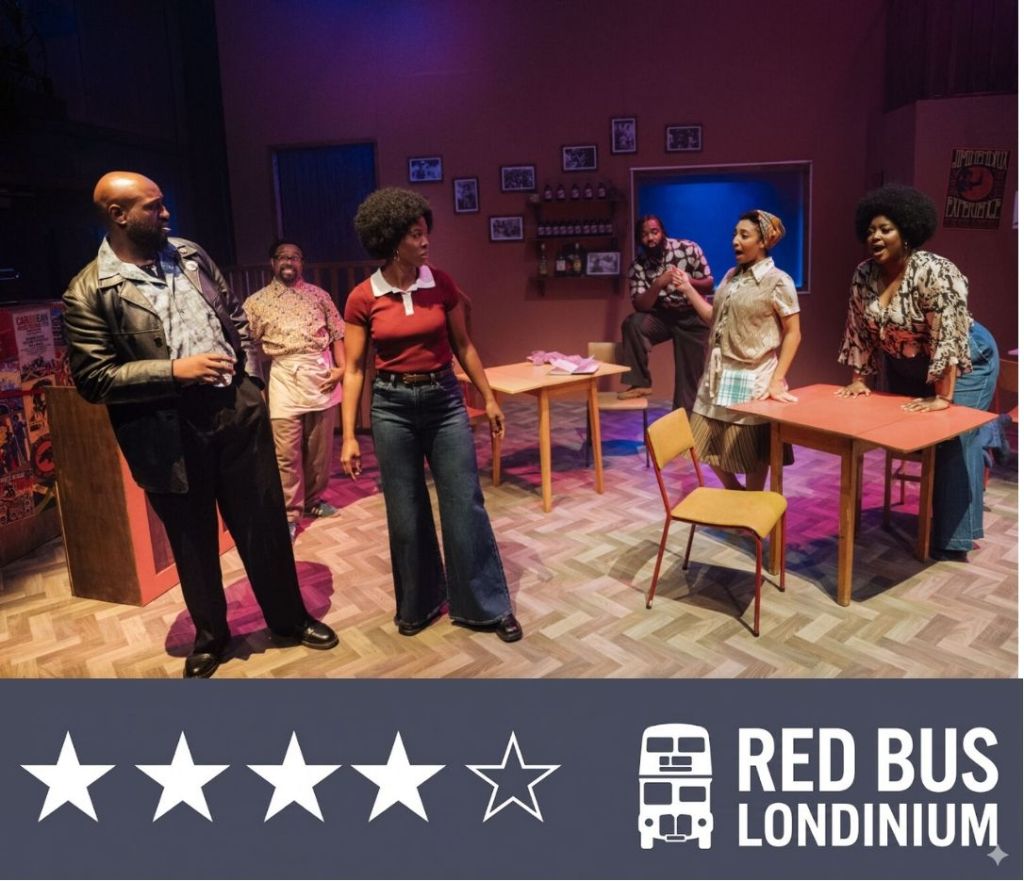
Black Power Desk, an original musical highlighting 1970s Black British protest, is making its world premiere at new South London venue, Brixton House. A sharp, soulful snapshot of its time, it is political yet deeply personal, with music that pulses with the heartbeat of the 1970s. The audience is invited into the action (with requests to clap, vote, react) which creates a shared connection and intimacy throughout.
Black Power Desk takes its name from a covert unit established in 1967 by then Labour Home Secretary Roy Jenkins and operated out of Scotland Yard. Tasked with monitoring British Black Power groups, it gathered and assessed intelligence, which it shared with Special Branch, MI5, the Home Office, and the Foreign and Commonwealth Office. Active into the 1990s, it was one of several such desks – others focused on the IRA, Marxists, and Trotskyists. Its surveillance tactics included the use of informants, infiltration, and even intimate relationships. Each of these intrusive methods, and their painful impact, are explored.
In less skilled hands, Black Power Desk could have veered into lecture or polemic and there are occasional moments where it edges in that direction. However, Urielle Klein-Mekongo (book, lyrics, and composition) and Gerel Falconer (lyrics and rapperturgy) have crafted a show that weaves the personal tightly with the political. We experience the turbulence of the era through the eyes of grieving sisters Celia, or CeCe (Rochelle Rose), and Dina (Veronica Carabai), whose diverging paths strain and distress their bond. Rose conveys sorrow and vulnerability with striking depth, while Carabai is a powerful presence. She emanates strength but is also flirtatious and teasing at times, drawing the audience in with irresistible charm.
The heart of the play’s action is set at the Drum restaurant, clearly inspired by the real-life Mangrove restaurant in Notting Hill. Described by a Trinidadian migrant, the Mangrove was, ‘like a sanctuary. It was family, a base for support.’ More than just a place to eat, it served as a vital meeting space for community organisers, activists, and intellectuals. Its cultural significance drew well-known figures such as Jimi Hendrix, Bob Marley, Diana Ross, Marvin Gaye, Nina Simone, Sammy Davis Jr, and Vanessa Redgrave. Klein-Mekongo’s script and Natalie Pryce’s set beautifully capture this sense of a vibrant community hub – alive with energy and solidarity – while also conveying the growing frustration at the harassment and targeting of even the simplest family gatherings.
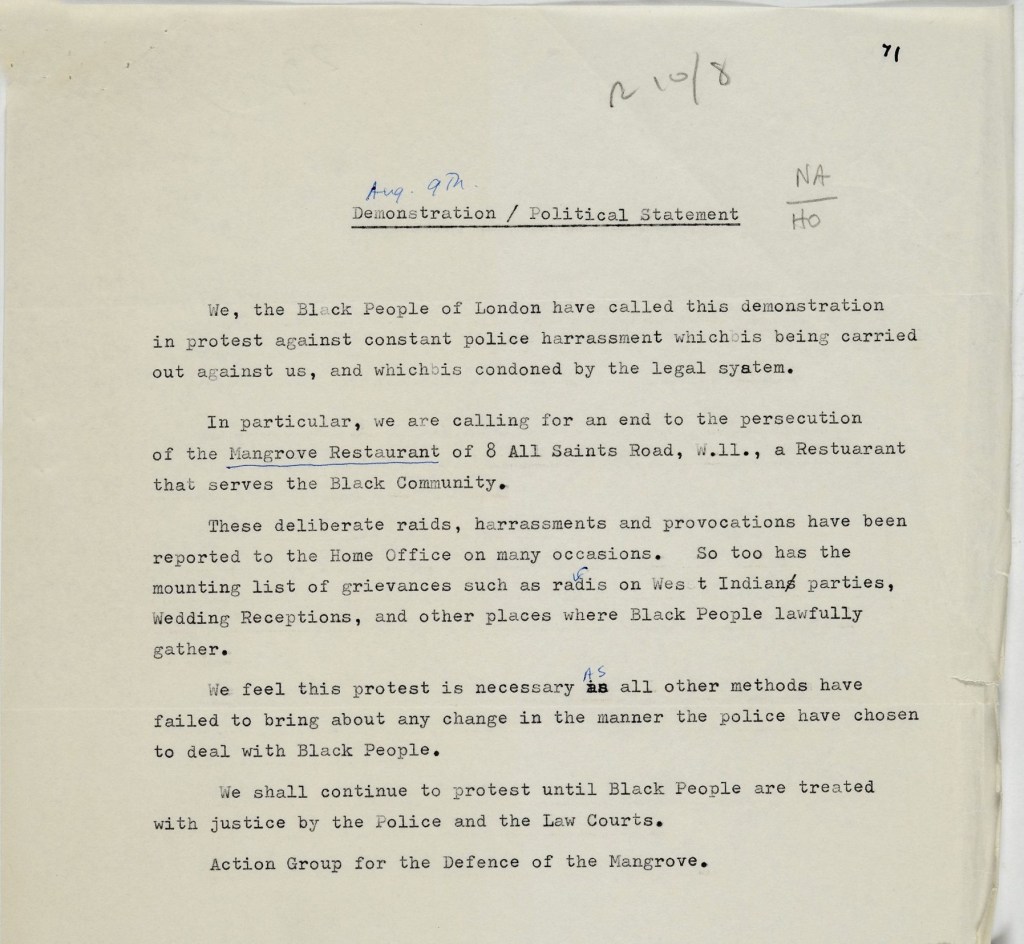
National Archives, Catalogue ref: HO 325/143
The ensemble is strong. Some lyrics were slightly harder to hear and the intimate size of the theatre made some choreography harder to fit. However, Black Power Desk succeeds as a powerful, cohesive whole. It shines a stark light on a shadowed chapter of history, yet never loses its humanity; haunting lyrics echo themes of Black anger, female strength, and the torment of being unseen.
This is a vital piece of theatre that deserves a wide audience. A visit to this welcoming new venue comes highly recommended.
Latest reviews:
- Review: Lighthouse, Courtyard Theatre *** ½

- Review: John Proctor Is A Villain, Royal Court ****

- Review: A Mirrored Monet, Charing Cross Theatre **

- Review, Yentl, Marylebone Theatre, ****

- ATG Discounts with Student Beans

- Review: Jaja’s African Hair Braiding, Lyric Hammersmith ****
- Review: Welcome to Pemfort, Soho Theatre ****

- Review: Waitress Musical, New Wimbledon Theatre *****
- Review: Choir Boy, Stratford East ****

- Review: Squidge, Riverside Studios ****

- Review: Summer Folk, National Theatre **** ½

- Review: Ancient Grease, The VAULTS ***


 Red Bus Londinium Life
Leave a comment